


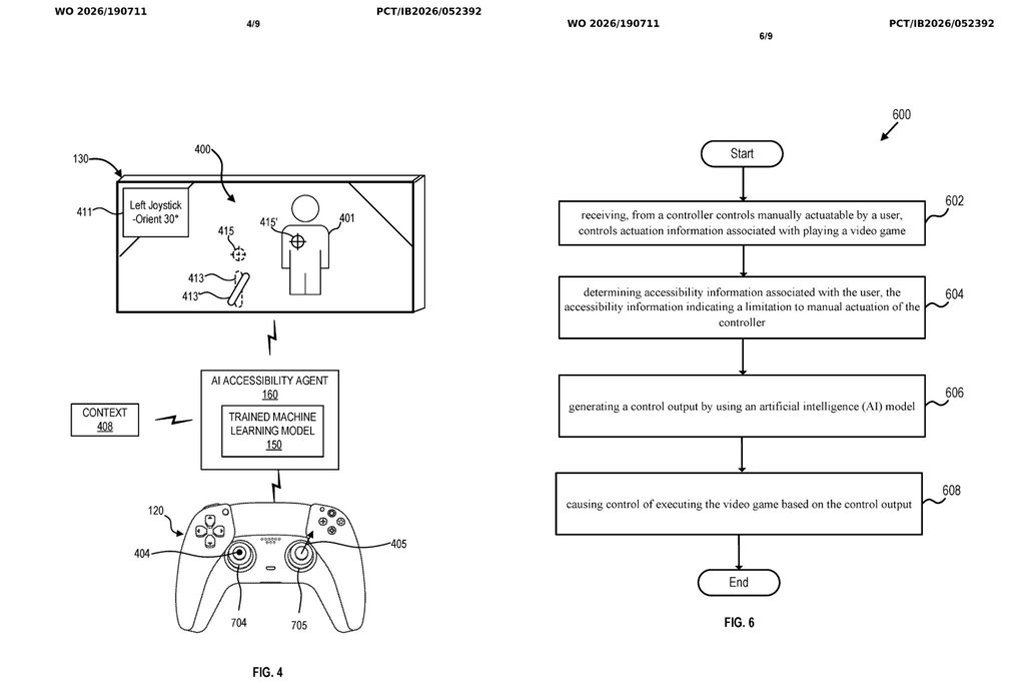
Sony has filed yet another AI patent, this time describing a system that would watch how a player fumbles with a controller and generate the inputs they clearly meant to make. Admittedly, this one isn’t nearly as dumb as some of the other ones. The filing, published on September 17th, outlines assistance specifically tailored to physical limitations: if your hand can’t quite reach a trigger, your thumb drifts on the stick, or you’re managing a disability that prevents full actuation, this AI compensates in real time.
It’s framed as an accessibility tool, which it genuinely could be. The system learns individual movement patterns, adapts to specific controllers, and responds to game context. The patent even includes sensible multiplayer safeguards: an on-screen indicator shows whether accessibility assistance is active, forestalling accusations that someone’s gained an unfair advantage. Local processing or cloud offloading are both options. The whole thing is controller-agnostic, technically applicable across hardware ecosystems, though the obvious destination for anything Sony patents is PlayStation.
Here’s the familiar rub: this is a patent filing, not an announcement of features shipping to your PS5 next month. Sony routinely describes technologies that never materialize beyond the filing itself. Patents are speculation wrapped in legal language, filed defensively to protect intellectual property and build portfolios. Sometimes that speculation becomes real. Often it doesn’t. You cannot bank on this actually arriving on PlayStation hardware.
That caveat matters because Sony’s relationship with AI patents has become a running ritual: announce an ambitious (albeit occasionally stupid) idea, let years pass, eventually either ship something simplified or abandon the project. The studio that owned the filing could have made this a straightforward accessibility win. Instead it exists in patent purgatory, documented but unconfirmed, potentially valuable or potentially vaporware depending on which executive greenlights what in some future fiscal year.
The underlying concept itself isn’t suspect. Adaptive input compensation for physical constraints is genuinely useful accessibility work. Open-source projects like Horos have explored similar territory. What makes this tiresome is the pattern: Sony patents the idea first, announces the patent second, and then leaves players wondering whether this will actually land on hardware or merely serve as defensive IP.
If and when this surfaces on a PlayStation console, it will probably be impressive. For now, file it under “interesting proposal with no confirmed ship date.”
Source: Insider Gaming

2 Comments
And you thought input lag was bad before. Just wait until you have to wait four or five seconds for an input to be read.
Although let’s be serious, this patent will go nowhere. It’s barely even an idea. It’s basically “What if a controller, could know what you wanted to press before you pressed it?” But upon scrutiny, that makes no sense. Accessibility? Well it’s based on how you play, so it’s useless there. You’d need to give i tot someone who doesn’t have a disability first, and then hope it stops learning from the user. And as for other uses… what other uses? Unless technology suddenly quadruples in specs, this thing will be too slow to adapt to those minor fumbles.
They’ve made the patent so they can sue anyone who makes something similar. Which is doubtful to ever happen, but you never know.
Занимаются всякой чепухой, а хорошие игры разучились делать!