

Some of the best retro projects start with a perfectly unreasonable question. This first trip around the workbench collects a smattering of small hardware and software experiments, from a radio rescued out of a dead meme to a Dreamcast reading Nintendo cartridges.
Fernandoalves25’s SF900 ESP32 Dongle rescues the radio section from a dead Data Frog SF2000 and wires it to an ESP32-S3. The result receives the inexpensive SF900 controller and sends its inputs over USB or Bluetooth Low Energy. A switchable second mode provides USB networking for a Wi-Fi-less handheld such as the R36S. Our earlier Data Frog coverage did not predict this afterlife.
Launchstation is NathanNeurotic’s dashboard, file manager and homebrew launcher for the PlayStation 2. Built on wLaunchELF_R3Z, it brings application browsing, save tools and external game-loader integration into a controller-driven interface. Add-on packages offer different controller support, even adding DualShock 3 and 4 connections.
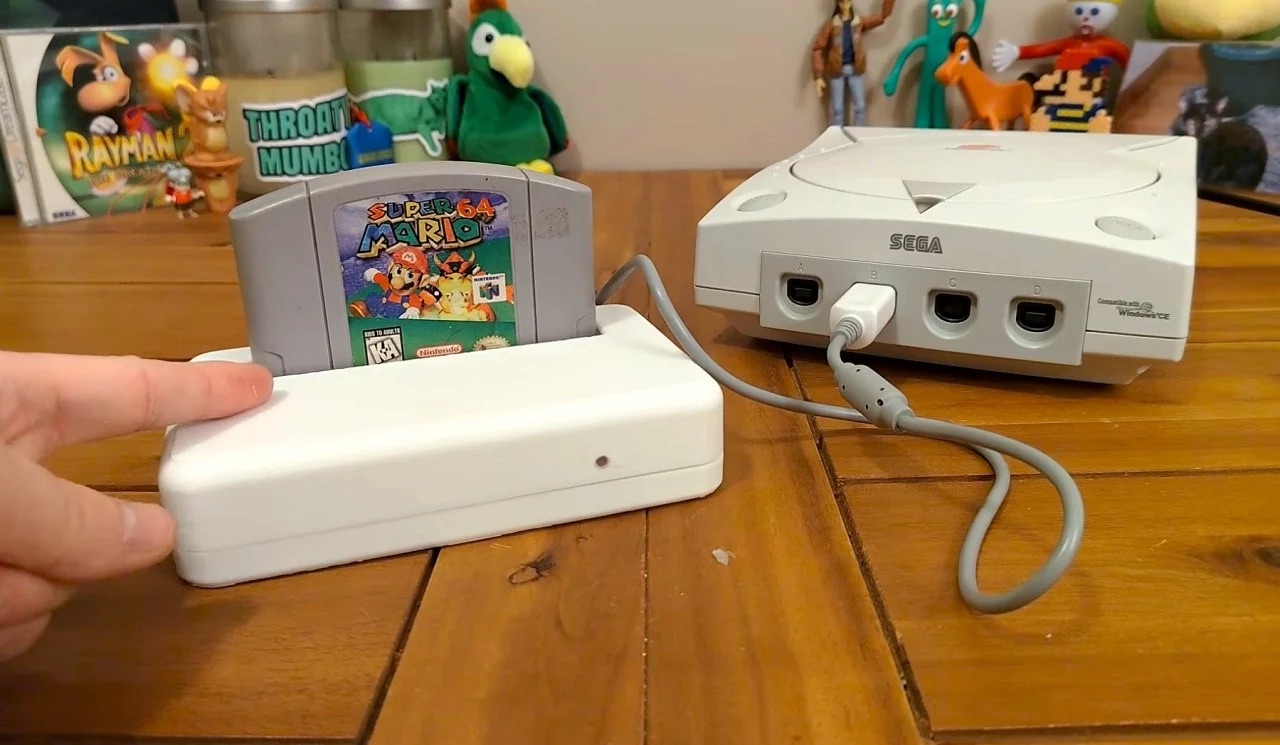
ThroatyMumbo’s Dreamcart is a set of DIY cartridge readers for the Dreamcast. Custom hardware lets Sega’s console access physical N64, SNES and Genesis cartridges and supported save data, using emulation or an N64 dynamic recompiler.
The creator lists limited compatibility and warns that cartridge save data could be lost. Backups and a throwaway cartridge are recommended before experimenting. A VMU stands in for an N64 Controller Pak; transferring an actual Controller Pak’s contents is not supported.
Lilvo’s DS Micro reached its first fully working prototype in a November 16 build log. The little clamshell now has shoulder buttons, headphones and a lid sensor that tells the system to save and quit before power switches off. Each display exposes a 256-by-192 window for pixel-for-pixel DS output.
The creator still wants louder speakers, better headphone switching and more shoulder-button travel. It remains in development, not available to buy. Where DualStation moves a DS under the television, Lilvo is taking the two-screen idea in the opposite direction. The build log has real prototype photos, rough shell and all.
Joyfon is a DIY USB phone controller with a Game Boy-like button layout, printable enclosure files and custom PCB designs. Its storage build uses a 16 MiB flash chip, reserving 256 KiB for firmware and exposing the remaining 15.75 MiB as a writable USB drive alongside controller input.
That build is for the custom board, not a standard 2 MiB Pico. It does not run games itself: a phone or PC still supplies the emulator. Input reporting pauses during writes, safe ejection matters, and host compatibility, particularly iOS, still needs hardware testing.
Team VUEngine’s VUEPort is a free, open-source Virtual Boy emulator for browsers, Windows, macOS, Linux and VR, built around the Shrooms-VB core. Alongside rewind and save states, it supports VB Color, a fictional extension that adds color through patches for existing games. The team also openly credits AI-assisted coding in its frontend development.
Leave a comment below if you have a maker project that you think should be featured here! That’s all for this one, happy tinkering!
