

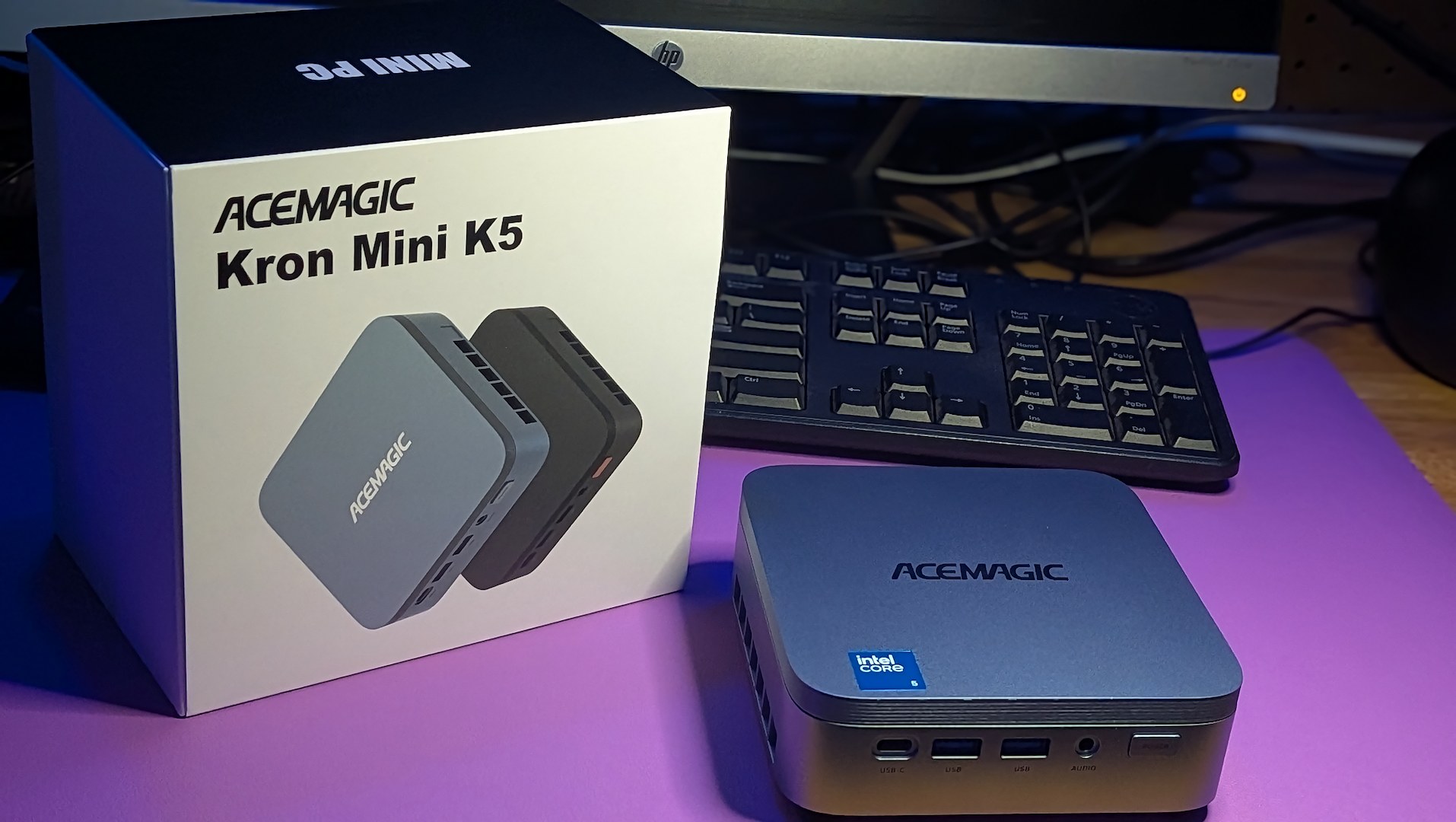
Mini-PCs are a lot like retro handhelds in a lot of ways. The constant flood of new model releases with similar capabilities makes finding new review angles a regular challenge. You can only write “great for everyday office desktop type use” so many times. Thankfully, when AceMagic sent over the new Intel Core 5 320-powered K5 ahead of release, I knew exactly what it was purposely built for.
Regardless of how you may personally feel about the usefulness, or what often feels like forced integration and ubiquity, of LLMs, they aren’t going anywhere anytime soon. The training was done. and Pandora’s Box is open, but that doesn’t mean you should have to pay a forever subscription to use one.
Disclosure:
The device reviewed was provided as a review sample by AceMagic. This had no bearing on the conclusion of the review, nor did AceMagic have the opportunity to make edits or changes to the review before publishing.
Affiliate links might be present where applicable, and we may earn a commission on product purchases using those links at no extra cost to you.
If you are someone who is inclined to use LLMs, then you have to decide which product to use in a sea of me-too services that are all pretty similar at the end of the day. Rather than pay for compute in the cloud, wouldn’t it be better to run these models locally, away from the prying eyes and conversation harvesting of big tech?
Apple saw a huge influx of business for its Mac Mini lineup of silicon, and now it’s Intel’s turn to throw its hat in the mix. Can the new Wildcat Lake generation close the performance gap? And at an MSRP of $600, does the K5 justify a similar price tag as Apple’s unusually affordable Mac Mini?
Specifications
I’ve played around with local models on my Unraid server before via Ollama and OpenWebUI. While I’m not inclined to involve it in my writing life anytime soon, it has proven a handy tool to have access to locally when I’m diagnosing networking issues at 1:30 in the morning. Much easier to paste logs to a local model I know isn’t phoning home to anyone with my addresses and topography.
| Ace Magic K5 – Intel | |
|---|---|
| Hardware | |
| CPU | Intel Core 5 Processor 320 (Wildcat Lake) |
| Cores/Threads | 6 cores/6 threads |
| GPU | Intel Xe Graphics (2 Xe cores), up to 2.5GHz |
| NPU | Intel AI Boost, 16 TOPS INT8 |
| RAM | 16GB LPDDR5 6400MT/s (soldered, non-upgradeable) |
| Storage | 512GB NVMe PCIe 3.0×4 SSD pre-installed; Dual M.2 2280 NVMe PCIe 4.0×2 slots for expansion |
| Connectivity | |
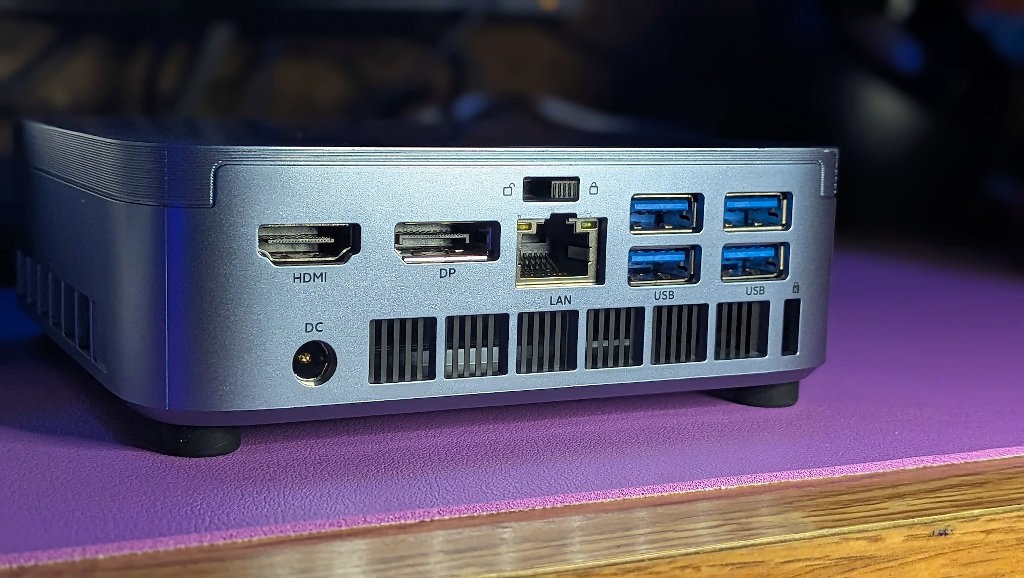
| Display Outputs | Triple 4K@60Hz: HDMI 2.0, DP 1.4, USB-C DP 1.4 |
| Network | WiFi 6, Bluetooth 5.2 (M.2 2230 card), 1× 2.5GbE LAN |
| Audio | 3.5mm Headphone Jack |
| Physical | |
| Dimensions | 128mm × 128mm × 41mm (square chassis) |
| Weight | 436g (per my postal scale) |
| Software | |
| OS | Windows 11 Pro (custom OEM install, offline setup recommended) |

Geekbench
Geekbench AI Benchmarks
I’ll fully admit that this is the first time I’ve ever even run AI benchmarks in Geekbench before. I have a loose understanding of what the metrics mean, but I’m as new to all of this as this hardware is to the market.
What I do know is that the numbers clearly outline the NPU’s specialized precision with quantized operations (INT8), outpacing the CPU by over 5x. Since LLMs rely heavily on quantized processing for generating text, it’s safe to say that the NPU is able to do a lot of heavy lifting with this modest hardware setup.
| Framework / Backend | Hardware | Single Precision (FP32) | Half Precision (FP16) | Quantized (INT8) |
|---|---|---|---|---|
| OpenVINO (NPU) | Intel AI Boost | 1,663 | 17,426 | 28,037 |
| OpenVINO (iGPU) | Intel Xe Graphics | 4,665 | 15,174 | 19,802 |
| ONNX (DirectML) | Intel Xe Graphics | 3,227 | 6,430 | 2,331 |
| OpenVINO (CPU) | Intel Core 5 320 | 1,632 | 1,190 | 4,372 |
| ONNX (CPU) | Intel Core 5 320 | 2,358 | 1,231 | 4,997 |
CPU Benchmark
AceMagic K5 CPU Geekbench 6
| wdt_ID | wdt_created_by | wdt_created_at | wdt_last_edited_by | wdt_last_edited_at | Device | Single | Multi |
|---|---|---|---|---|---|---|---|
| 1 | andrew | 26/02/2026 04:08 PM | nick | 06/08/2026 04:26 PM | Origimagic C5 (AMD Ryzen 5 3500U) | 1,034 | 2,696 |
| 5 | andrew | 18/03/2026 10:27 AM | andrew | 18/03/2026 10:27 AM | AceMagic M1 (13900HK) | 2,545 | 8,976 |
| 6 | andrew | 18/03/2026 10:28 AM | nick | 06/08/2026 04:26 PM | AceMagic K1 7430U | 1,888 | 6,902 |
| 7 | andrew | 18/03/2026 10:28 AM | nick | 08/08/2026 12:53 PM | AceMagic K5 Intel Core 5 320 1500MHz (6 Cores) | 2,283 | 7,637 |
| 8 | andrew | 18/03/2026 10:28 AM | nick | 06/08/2026 04:30 PM | Acemagic Vista V1 (Intel N150) | 1,084 | 2,870 |
So What is an NPU, Anyway?
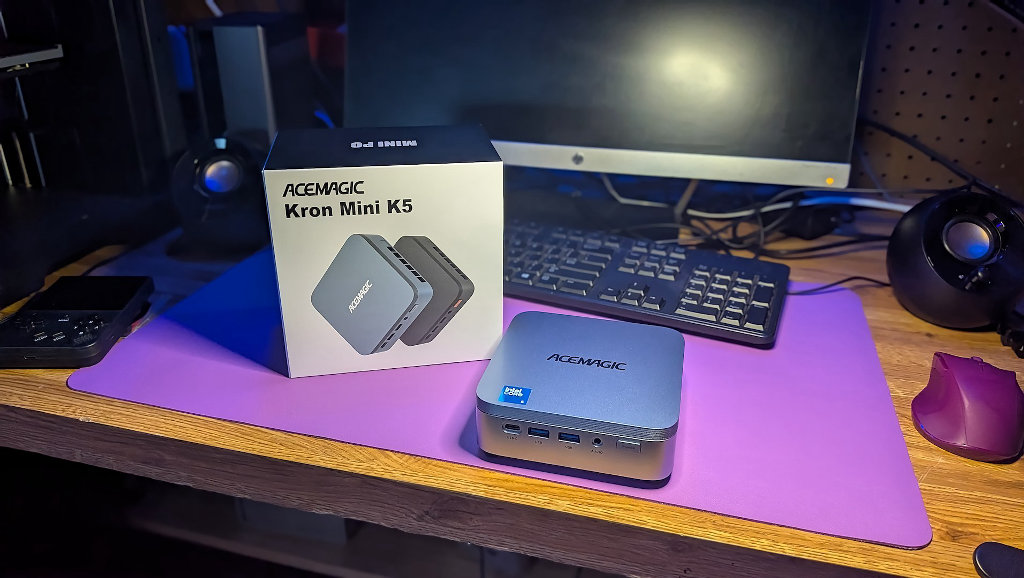
NPUs are a recent addition to the hardware landscape, so if you’re wondering what they even are, here’s the quick version. The NPU is a dedicated chip used for neural-net inference. The chip serves as an extra computational engine beyond the CPU and GPU.
The analogy that helped me understand was that of the frozen burrito. The CPU is like your kitchen’s oven. It’s a versatile piece of equipment that can bake bread, roast meats, or warm up your burrito. And it will do a good job, but it takes time to preheat the oven, and the thawing and cooking of the frozen burrito is going to be a while.
An NPU is akin to the microwave. It may not be able to bake bread or roast meats, but it’s the quickest and most power-efficient way to heat that frozen burrito. A single-use appliance, but it does the job it’s tasked with exceptionally well when compared to traditional methods.
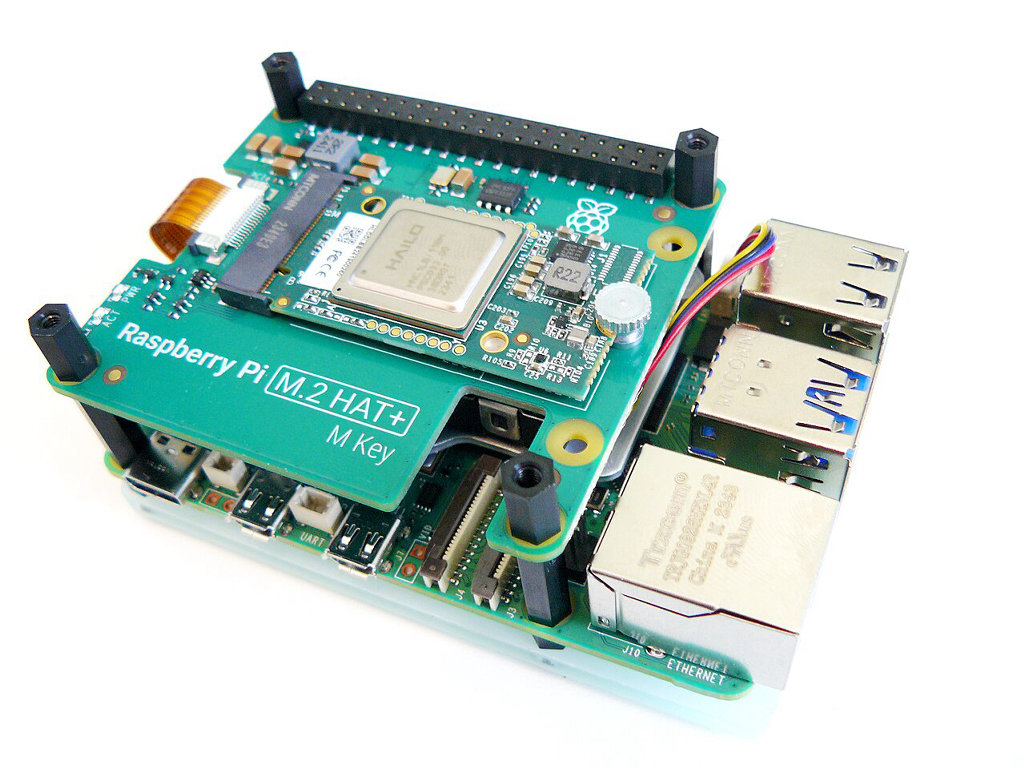
The NPU almost seems like dead weight in traditional office application work. It ignores all the general goings-on of the CPU world, and only comes out to flex its muscles when it’s time to crunch some neural matrix multiplication network maths. That math is the frozen burrito that it’s exceptionally efficient at heating. The CPU oven will get you there eventually, but the NPU is for when you’re hungry now.
Testing
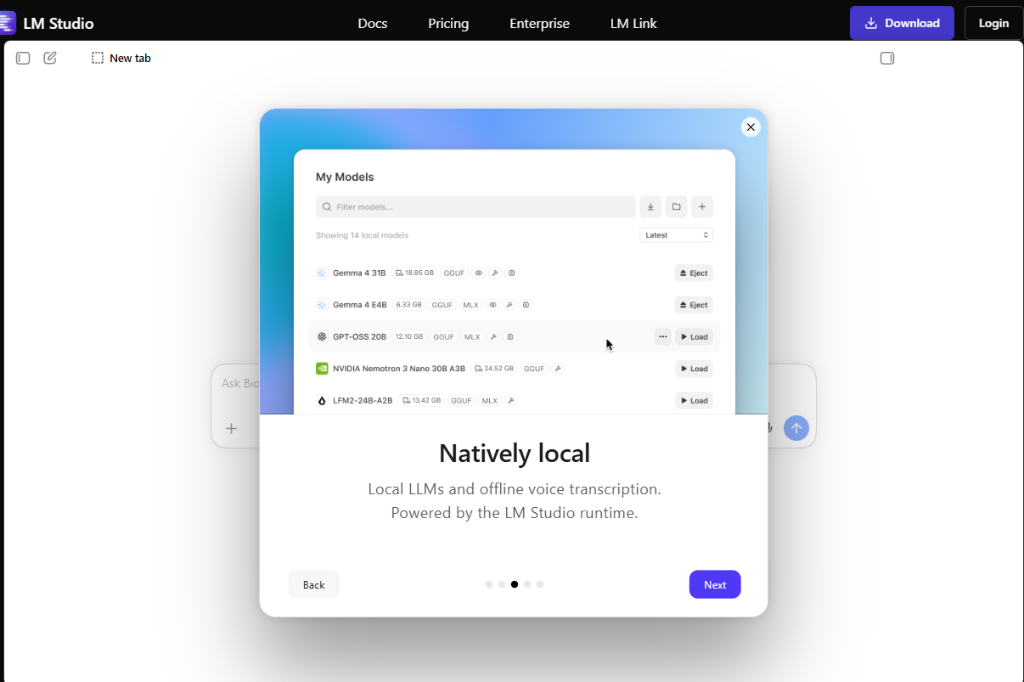
Proving just how new the Intel 320 chip is, I hit some snags early on in testing. I tried to use LM Studio Bionic, but it defaults to a Vulkan back-end powered by the GPU. There is no NPU/OpenVINO support in the program yet, so trying to benchmark the LLM performance is null out of the box. We can’t ascertain how this specialized hardware handles local AI workloads compared to more standard PC builds if we don’t have the software integration to make it work.
I considered moving things from the default installed Windows 11 Pro in order to gain an additional ~4GB of RAM headroom, but I thought it best to test the hardware as sent. A standard Windows desktop experience is a non-negotiable requirement for a large percentage of the prospective market, so we’ll see how things work in that default environment.
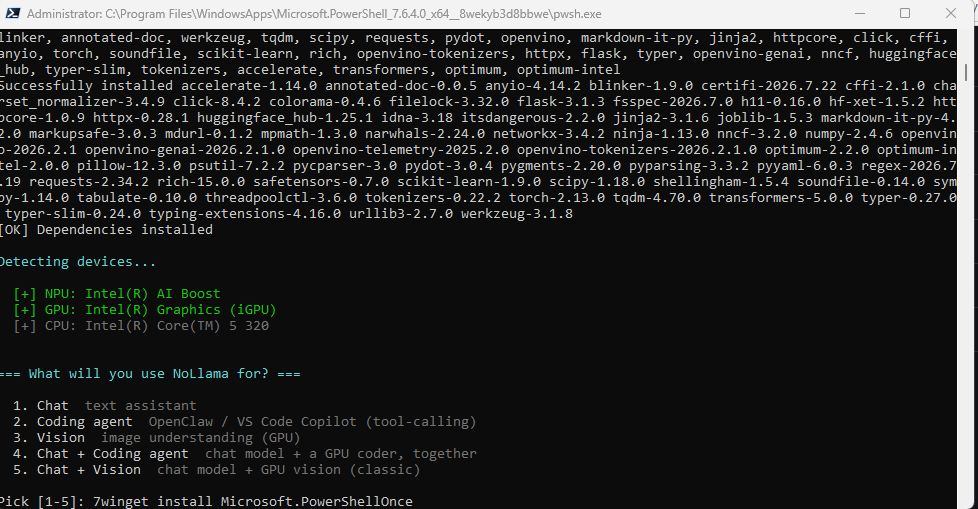
Poking around the web, I was able to find the OpenVINO-based NoLlama. An Intel-only tool specifically designed to take advantage of NPU acceleration in a Windows environment. The method lacks a GUI at the time of writing, and you’ll have to have your conversations in a PowerShell terminal window (with Git for Windows installed) for the time being, but it takes the computing path that we need it to.
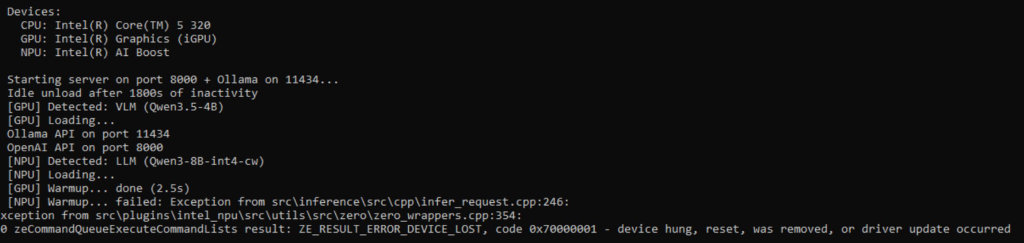
Early attempts within the command line structure proved frustrating. I repeatedly ended up with a (ZE_RESULT_ERROR_DEVICE_LOST) error. The system could see the NPU, but when it attempted to initialize the chip for an LLM workload, it crashed.
Final Hour Drivers To The Rescue
Just as I was getting ready to throw in the towel and say that AceMagic might be putting the cart before the horse a bit with this release, Intel released new drivers (32.0.100.4841). The new patch fixed my earlier crashes right away. It was as I’d expected. The software just lacked the proper driver instructions to communicate with the NPU. The Wildcat was finally out of its cage.
The pathway that previously failed to initialize was fixed by the wonderful new drivers, and we could now host a local LLM model instance and communicate with it via Inferbridge.
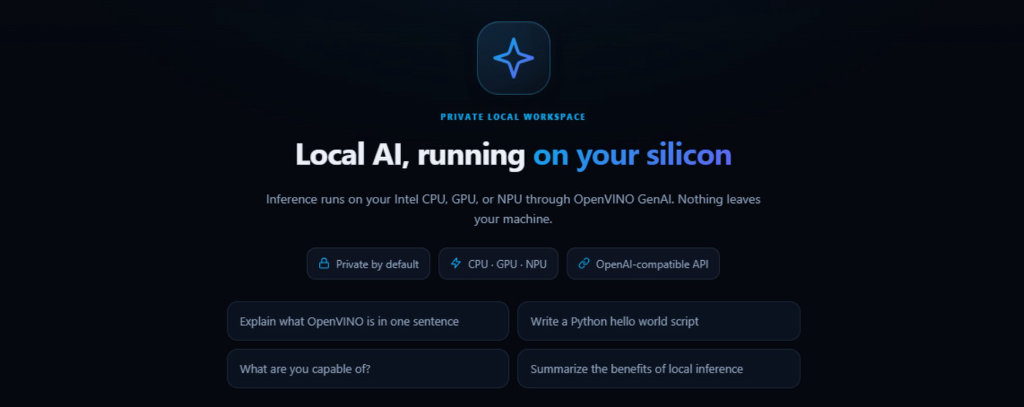
To test functional performance on the Wildcat NPU, I opted for the lightweight conversational model, TinyLlama-1.1B-Chat. I’m not going to pretend like this static model wasn’t dumb as a box of rocks out of the gate, but it’s proof that the pipeline is functional. Anyway, here’s how it fared:
- Thought Generation: The K5’s Wildcat Lake NPU sustained an average generation speed of 17.1 tokens per second. This translates to about 13 words per second of text generation, or a little more than double the rate that most people read (5-6 words per second). Generally, the more complex the prompt, the slower the tokens per second rate, but it varied a bit.
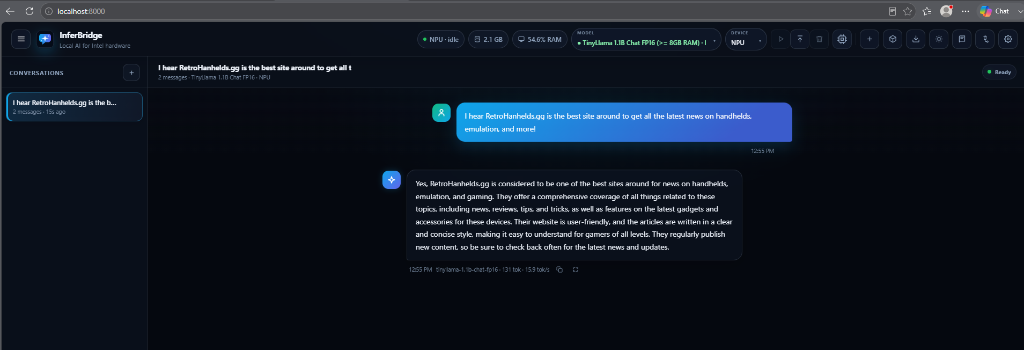
- System Load: As the LLM processing is passed off to the NPU, the CPU usage during generation remains low and stable, hovering between 12-15%. RAM was a similar story, with the operations never eclipsing 60% of the total system memory. System hung events simply didn’t occur, presumably because the CPU and RAM still have plenty of headroom to handle all of the Windows background tasks while the NPU does its thing with text generation.

- Efficiency: The Intel Core 5 320 is rated at only 15W base TDP. It can spike up to 35W under heavy loads, but during my testing the mini-PC remained whisper quiet. A testament to the NPU’s ability to shoulder the heavy lifting away from the CPU/GPU, negating the need to run up thermal throttling.
A Worthy Mac Mini Competitor?
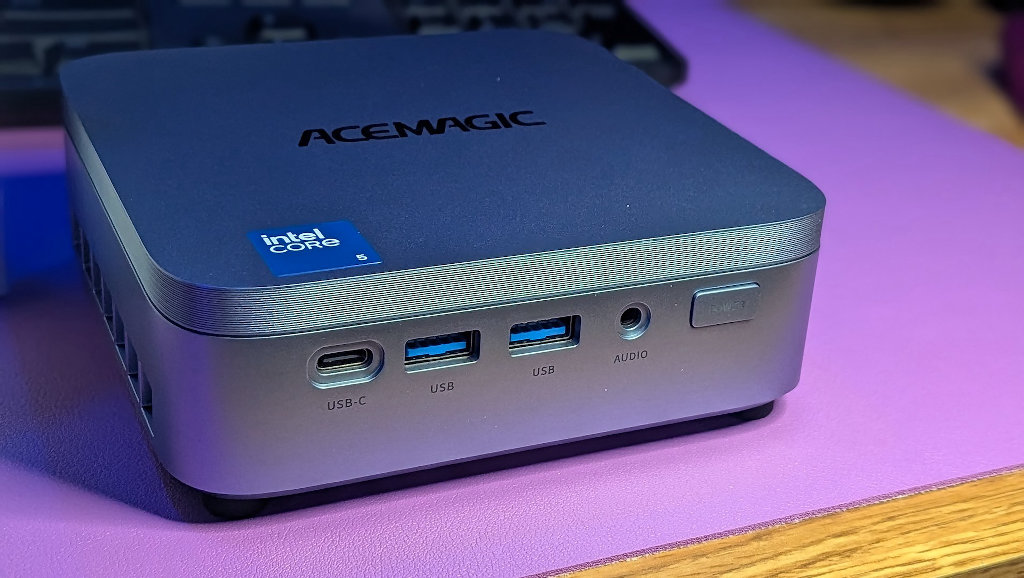
The Acemagic K5 and the Apple Mac Mini are both targeting the same $600 MSRP, so which should you consider? This is a difficult question as I’ve not had the chance to test Apple’s specialized silicon, and local LLMs are still more of an exploratory lark than a computing necessity for me. I can say that if you’re in the market for this type of specialized machine, the AceMagic does offer a few advantages that Apple’s silicon doesn’t come with:
- Networking: The K5 comes out of the box with a 2.5GbE port installed. Apple will ask for an upgrade fee to go beyond the stock 1GbE of the Mac Mini.
- Storage Options: AceMagic’s offering comes with dual M.2 PCIe 4.0 slots for storage expansion. Apple will charge you prices for storage expansion that would have made me blush in the before times, let alone with today’s costs.
- I/O: The first two generations of the Mac Mini maxed out at two external displays (current gens have righted this). The K5 can output to three monitors out of the box with HDMI/Displayport/USB-C native connectivity and without the need for costly proprietary Thunderbolt dongles.
Closing Thoughts
Up until the final hour in my nearly two weeks with the K5, it didn’t look like I’d be able to finish the review with a happy ending. The NPU could be seen by Geekbench and perform some local optimizations in Microsoft’s Copilot (who cares), but that was pretty much it.
Any real-world utility was out the door until Intel provided drivers to bring the hardware to life. And therein lies the problem. This hardware is just so new that unless you’re dead set on running a Windows-based small local LLM, things are still developing.
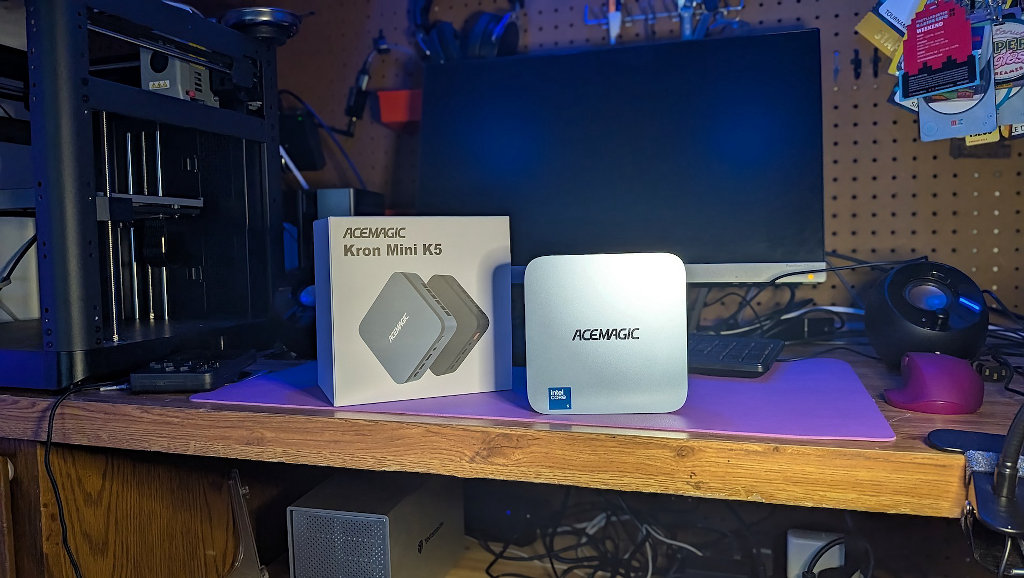
It’s difficult for me to recommend running out to pick something up that is barely just getting on its feet. Know that if you do, you’ll likely have to put up with some headaches (as I did) along the way. This is purpose-built hardware for a niche audience that wants it.
If it meets your criteria, I’d say there’s a worthy desktop machine with some extra bells and whistles in the NPU, but have your use-case sorted. Things are expensive right now, and $600 isn’t the kind of purchase you make on a whim. Models will continue to be refined.
Purpose-built AI hardware might be some of the only leaps forward in consumer electronics we see in the next 12 months while it’s still impossible to source components like RAM. I’m glad that someone is stepping up to challenge Apple in the space they fell backwards into dominating with their specialized silicon, but I’m going to take a “wait and see” approach before I dedicate myself to a major purchase for a technology still in its infancy.
