

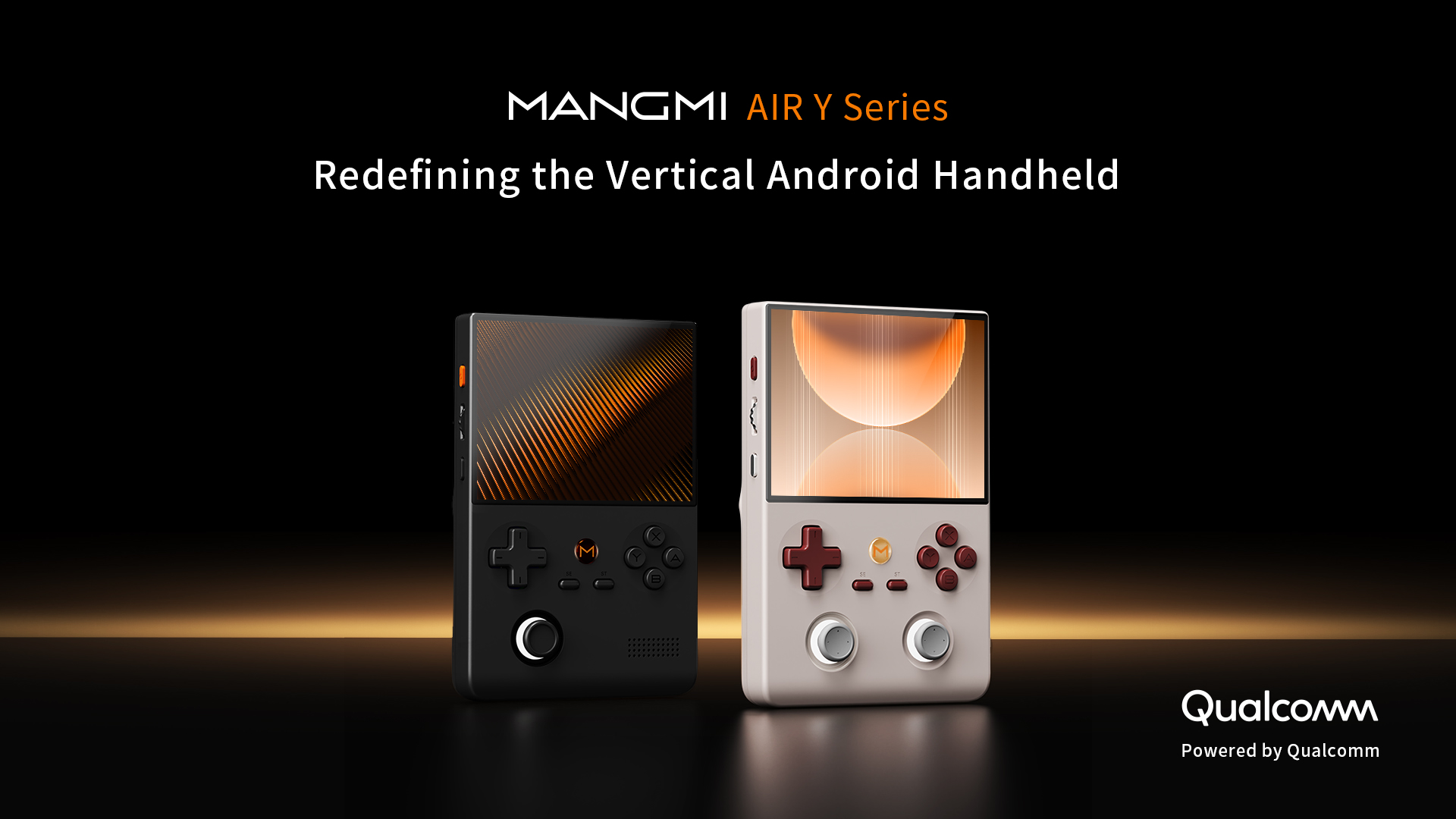
MANGMI has been teasing its foray into vertical handhelds for the past few weeks with the AIR Y and AIR Y Pro. Until now, the company had only shared screen details, the design, and that both handhelds are powered by Snapdragon processors. Earlier today, MANGMI pulled back the veil completely, revealing the entire spec sheet for both the AIR Y and AIR Y Pro.
Unsurprisingly, MANGMI is sticking with what it knows, meaning that the AIR Y is powered by the Snapdragon 662, while the AIR Y Pro makes use of the Snapdragon 865. For the unaware, these are the same processors that power MANGMI’s existing AIR X and Pocket Max handhelds. In doing so, there’s hope that the door is left open for the potential of custom firmware in the future, seeing as ROCKNIX and GammaOS are options for MANGMI’s existing handhelds.
| MANGMI AIR Y | MANGMI AIR Y Pro | |
|---|---|---|
| Screen | 4.2-inch IPS | 4.2-inch IPS |
| Resolution | 1280 x 960 (4:3) | 1280 x 960 (4:3) |
| CPU | Qualcomm Snapdragon 662 | Qualcomm Snapdragon 865 |
| GPU | Adreno 610 | Adreno 650 |
| Active Cooling | ✅ | ✅ |
| RAM | 3GB LPDDR4XX | 4GB / 8GB LPDDR4X |
| Internal Storage | 32GB eMMC | 64GB UFS 2.1 / 128GB UFS 3.1 |
| External Storage | microSD | microSD |
| Battery | 5000mAh w/ 15W Charging | 5000mAh w/ 18W Charging |
| Connectivity | Wi-Fi 5 / Bluetooth 5.0 | Wi-Fi 6 / Bluetooth 5.1 |
| Speaker(s) | Mono (Front-firing) | Stereo (Bottom-firing) |
| Extras | Customizable Key / Volume Wheel / 6-Axis Gyro | Customizable Key / Volume Wheel / 6-Axis Gyro |
| Ports | USB-C, microSD, 3.5mm Audio Jack | USB-C, microSD, 3.5mm Audio Jack |
| Dimensions | 144.84 x 94.64 x 23mm | 144.84 x 94.64 x 23mm |
| Weight | 279g | 286g |
| Software | Android 14 | Android 13 |
Beyond that, there’s really not much that stands out when looking at the rest of the spec sheet, as it all pretty much lines up with what we expected. However, I will say that I appreciate MANGMI offering the AIR Y Pro with two RAM options, although I have to wonder just how long that will last. It’s worth noting that the lower 4GB model will include the slower UFS 2.1 storage, while the 8GB model gets bumped up to UFS 3.1.
All that remains is for MANGMI to reveal how much the AIR Y and AIR Y Pro will actually cost, and when we’ll be able to get our hands on them. Depending on that, MANGMI might end up driving the nail in the coffin of the TrimUI Brick Pro U before it’s even able to get off the ground. Otherwise, we might end up having an entirely different conversation about the state of handhelds and whether it might be more prudent to go with traditional retro handhelds for the time being.
