

Not too dissimilar from what happens every time the Game of the Month voting rolls around, it would appear that there’s some collusion taking place amongst three of the largest RAM manufacturers. A new class action lawsuit (via Law360) has been filed in California claiming that Samsung, SK Hynix, and Micron are to blame for “RAMageddon.”
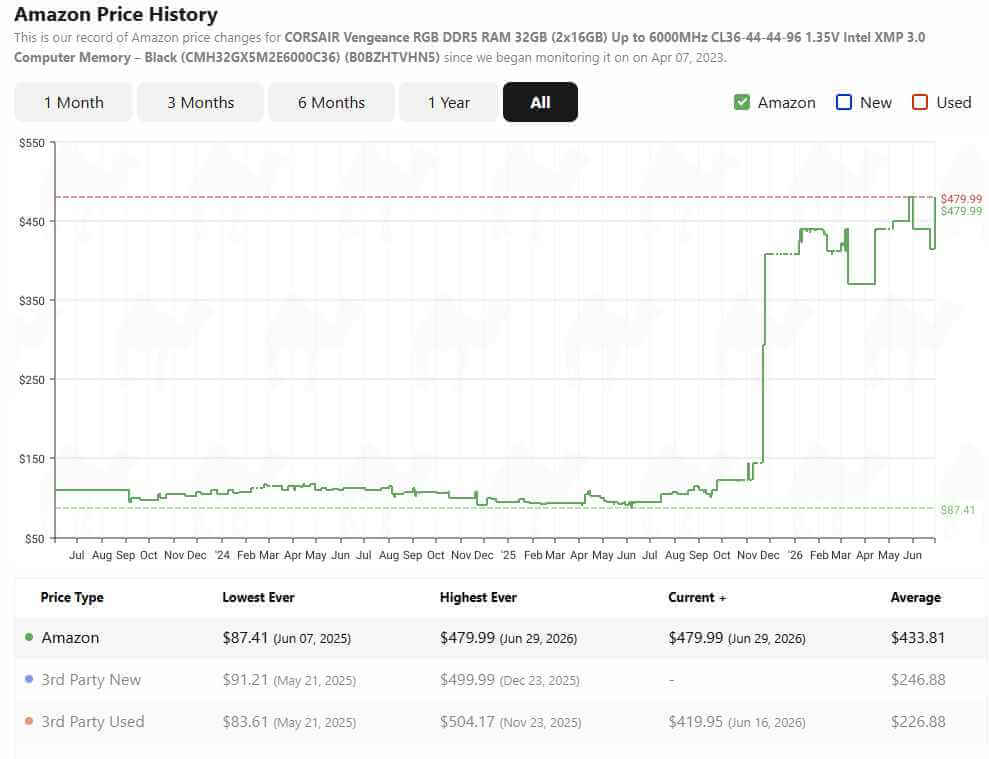
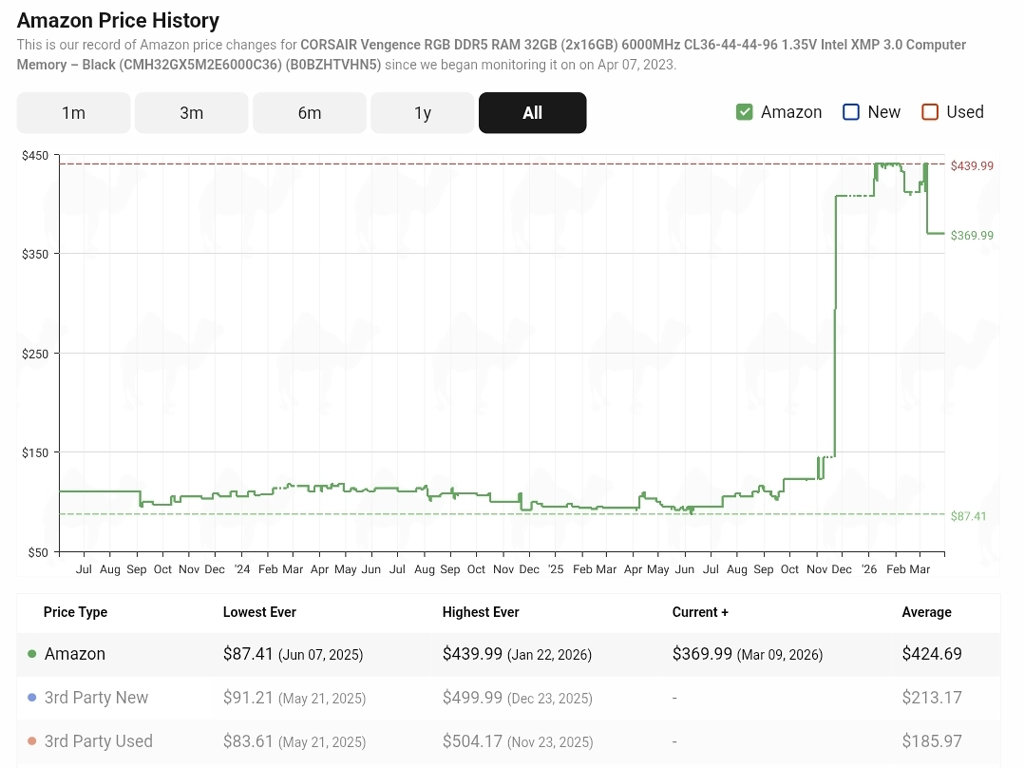
As noted by Law360, DRAM prices have increased by an eye-watering 700% over the past four years, with the companies being accused of fixing prices starting back in 2022.
“The DRAM oligopolists have simultaneously cut production, coordinated a pivot to [high bandwidth memory] and exit from [Double Data Rate 3] and [Double Data Rate 4], and otherwise decreased and locked up conventional DRAM supply while prices charged up with mind-blowing scale and rapidity.”
Case 3:26-cv-0634 via Law360
Considering that Micron, Samsung, and SK Hynix “make almost all of the world’s supply of dynamic random access memory,” this has left the market with no other choice but to raise prices in an effort to offset some of the costs. As one can imagine, this lawsuit doesn’t just target the rising costs for consumers in terms of grabbing some new RAM and storage. It’s also forced even the largest companies to raise prices when it can no longer afford to sell products at a loss.
Frankly, RAMageddon is effecting just about everything and anything with a built-in SoC. It’s the reason why Sony, Microsoft, and Nintendo all announced higher prices for its respective consoles. Component costs is also the reason for the astronomical prices of recently introduced handhelds, such as the MSI Claw 8 EX AI+ and the OneXPlayer APEX, amongst others.
Just this morning, AYN announced yet another price increase, but it’s not limited to just the Thor or Odin 3, as the Odin 2 Portal is also seeing a $10 price jump. And of course, it’s the reason why AYN was forced to shelve the Odin 3 Ultra, and why Retroid retired the Pocket G2 while temporarily retiring the 12GB Pocket 6.
These issues aren’t just affecting the gaming segment, although it might seem it since that’s our main focus here. Recently, Apple announced price increases for many of its devices, ranging from $100 for the MacBook Neo and topping out at $1,300 for the M3 Ultra Mac Studio. Even the HomePod Mini, which was released in 2020, is now $30 more expensive due to rising component costs. Really, the examples could go on and on, but you get the general idea.
Much of these issues were assumed to stem from the explosion of AI over the past year, which saw Micron exit the consumer market entirely. However, if this lawsuit is to be believed, then all three companies have been essentially playing the “long game,” with 2025-2026 being the time that customers were set to be targeted.
Earlier this year, there was hope that the end of this nonsense was in sight, as Google’s TurboQuaint “potentially offered a 600% efficiency over current AI processing capabilities.” RAM prices dipped ever-so-slightly for a fraction of a second, before the prices started to skyrocket again.
I don’t know enough to say whether this class action lawsuit has a fighting chance to make an impact, or even if it’ll be a drop in the bucket. However, we’ll obviously be keeping a close watch on the situation to see how it unfolds.

2 Comments
Сговор гигантов производителей оперативной памяти, абсолютно очевиден, это было ясно, самого начала! А произвидители ssd, подтянулись к этой афере, это тоже очевидно! Алчные, корпоративные подонки!
I guess we’ll see what happens, but my take up until this point was that all of the RAM got snatched up by AI companies, forcing the prices to go up, and since people were still buying it at those inflated prices, they’ve continued to sell them at those high prices even as the shortage situation improved.
Now I’m not so sure.