
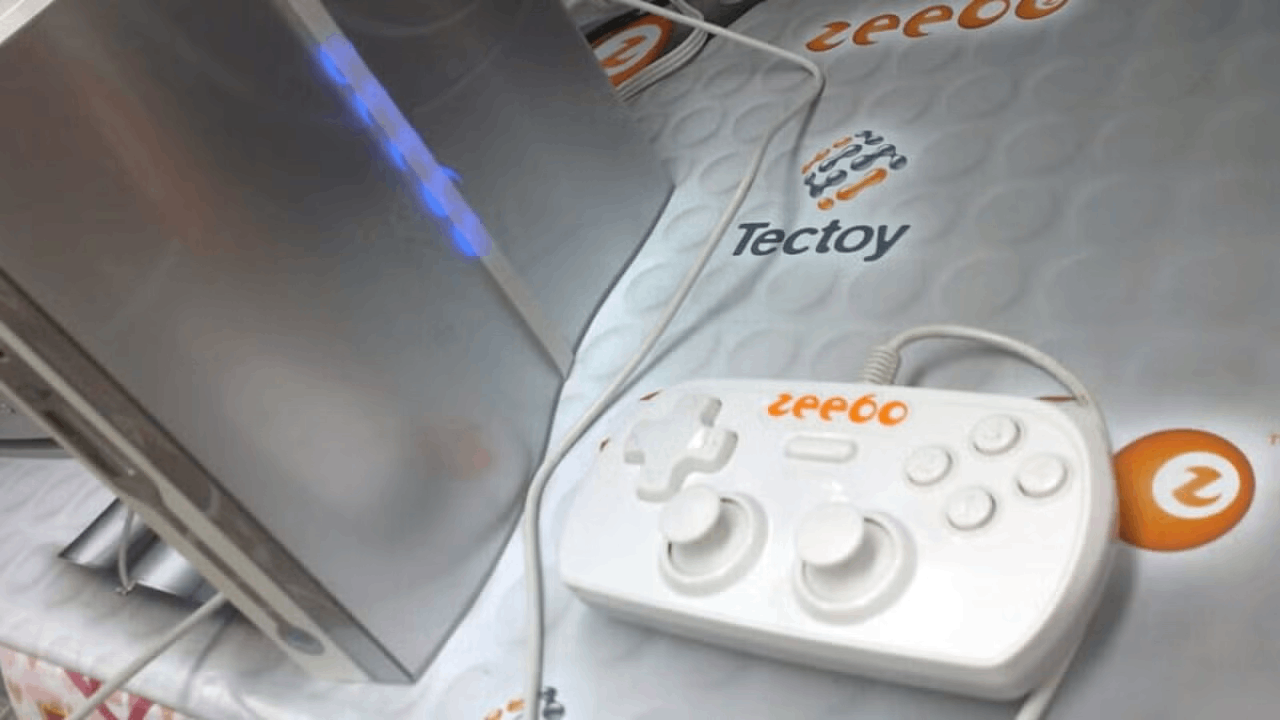
Zeebo Inc. was formed as a joint venture between Tectoy, the Brazilian company that had distributed Sega consoles in Latin America since the 1980s, and Qualcomm, the American telecom giant. The partnership was announced in November 2008 in Rio de Janeiro, with both companies targeting what they called “the next billion” consumers in developing markets like Brazil, Russia, India, and China. The pitch was straightforward enough: create an affordable seventh-generation console that delivered games wirelessly via 3G cellular networks, completely bypassing the piracy problems that plagued physical media in those regions.

The hardware ran on a 528 MHz processor with an ATI Imageon GPU, 160 MB of RAM, and could render 4 million triangles per second. This was mobile phone hardware dressed up as a home console, outputting a paltry 640×480 resolution to televisions and downloading games through 3G connections (with fallback to 2G networks). The Zeebo launched in limited quantities in Rio de Janeiro, priced at R$499 Brazilian reais, roughly $249 USD. The initial package included the console, one controller that strongly resembled the Wii Classic Controller, and three pre-installed games.

The Price Problem

The launch price was a disaster from day one. Brazil’s game market had been dominated for decades by cheap, locally-manufactured Sega Master System and Genesis clones that Tectoy still produced and sold for a fraction of that cost. While R$499 (approximately $100 USD) was cheaper than importing a PlayStation 3, Xbox 360, or Wii through official channels, it was expensive for hardware that was obviously several generations behind those systems. Zeebo Inc. wanted to drop the price to R$299 immediately, which would have made the system competitively priced with Tectoy’s 16-bit offerings, but Qualcomm refused and insisted on keeping the R$499 price point while bundling three free games.

The company relented within months, cutting the price to R$399 in September 2009, then again to R$299 in November 2009, finally reaching the price Zeebo Inc. had wanted from the start. The Zeebo launched in Mexico on November 4, 2009, initially priced at 2,499 Mexican pesos (approximately $205 USD), dropping to 2,249 pesos ($184 USD) by April 2010. National distribution across Brazil rolled out in December 2009, months after the initial Rio de Janeiro launch. The pricing confusion and multiple rapid cuts signaled to consumers that the company didn’t understand its own market.

A Library That Never Materialized

The Zeebo’s game library consisted of 73 titles total across its entire lifespan, mostly Java-based mobile game ports, Data East arcade classics, and downgraded versions of older console games. Quake 1 and Quake 2 were early highlights, demonstrating that the hardware could handle basic 3D games, but the ports suffered from unresponsive controls and compromised visuals compared to their PC and console counterparts. Ports like Crash Bandicoot Nitro Kart 3D and Resident Evil 4 Mobile appeared, but ran worse than the original versions despite the hardware being almost a full decade newer.

Several high-profile games were announced but never released. Sega had committed to porting Crazy Taxi and Sonic Adventure, which could have given the platform semi-legitimate marquee titles, but both were shelved for unknown reasons. The download-only distribution model meant every game had to fit within reasonable file sizes for 3G cellular networks, severely limiting scope and graphical fidelity. The BREW development environment was better suited for mobile apps than console gaming, making ports difficult and original development unappealing to most studios.

Expansion Plans That Went Nowhere

In 2010, Zeebo Inc. partnered with AT&T to use their 3G network, theoretically enabling Zeebo functionality in over 200 countries. The company announced plans to launch in India in 2010, China by 2011, and even hinted at a U.S. market entry in 2011. A limited India launch did occur in 2010, but China and the United States never happened. The hardware revisions showed some learning: later Brazilian and all Mexican units included a keyboard accessory and a redesigned controller that resembled the PlayStation 2 DualShock rather than the bulky Wii Classic-style original.

Sales figures were never officially released, but estimates suggest the Zeebo sold somewhere between 30,000 and 160,000 units total across all territories. For a console that spent millions on development, manufacturing infrastructure, and marketing, those numbers were catastrophic. The company had manufactured the Brazilian units in the Free Economic Zone of Manaus to take advantage of tax incentives, but the investment in local production couldn’t be justified by actual sales.

The Educational Pivot Nobody Asked For

Zeebo Inc. discontinued the console in 2011, just two years after launch. Rather than simply shutting down operations, Tectoy made the bizarre decision to reposition the Zeebo as an educational toy, a move that observers universally agreed made the situation worse. The Zeebo had failed as a game console; rebranding it as an overpriced learning device solved exactly zero of the problems that had killed it in the first place.

The Zeebo’s failure came down to fundamental mismatches between vision and execution. The idea of a digital-only console distributed via cellular networks made sense for regions with rampant piracy and poor physical distribution. But the hardware was too weak, the library too sparse, the price too high, and the competing options too compelling. Brazilian gamers could buy legitimate Tectoy-manufactured Sega consoles with deep libraries of classics for half the price, or they could pay more and import actual current-generation hardware. The Zeebo offered neither nostalgia nor cutting-edge performance, just outdated mobile phone internals pretending to be a console.

Tectoy and Qualcomm had partnered to create gaming hardware for developing markets, but they fundamentally misunderstood what those markets wanted. Sometimes, having experience doesn’t matter if you’re solving the wrong problem.

Share.

Jim is a dad from Massachusetts by way of the Northeast Kingdom (IYKYK). He makes music as Our Ghosts, and with his band, Tiger Fire Company No. 1. He also takes terrible photos, writes decent science fiction and plays almost exclusively skateboarding games. He cannot, however, grow a beard. Favorite Game: Tony Hawk’s Pro Skater

Leave A Reply