

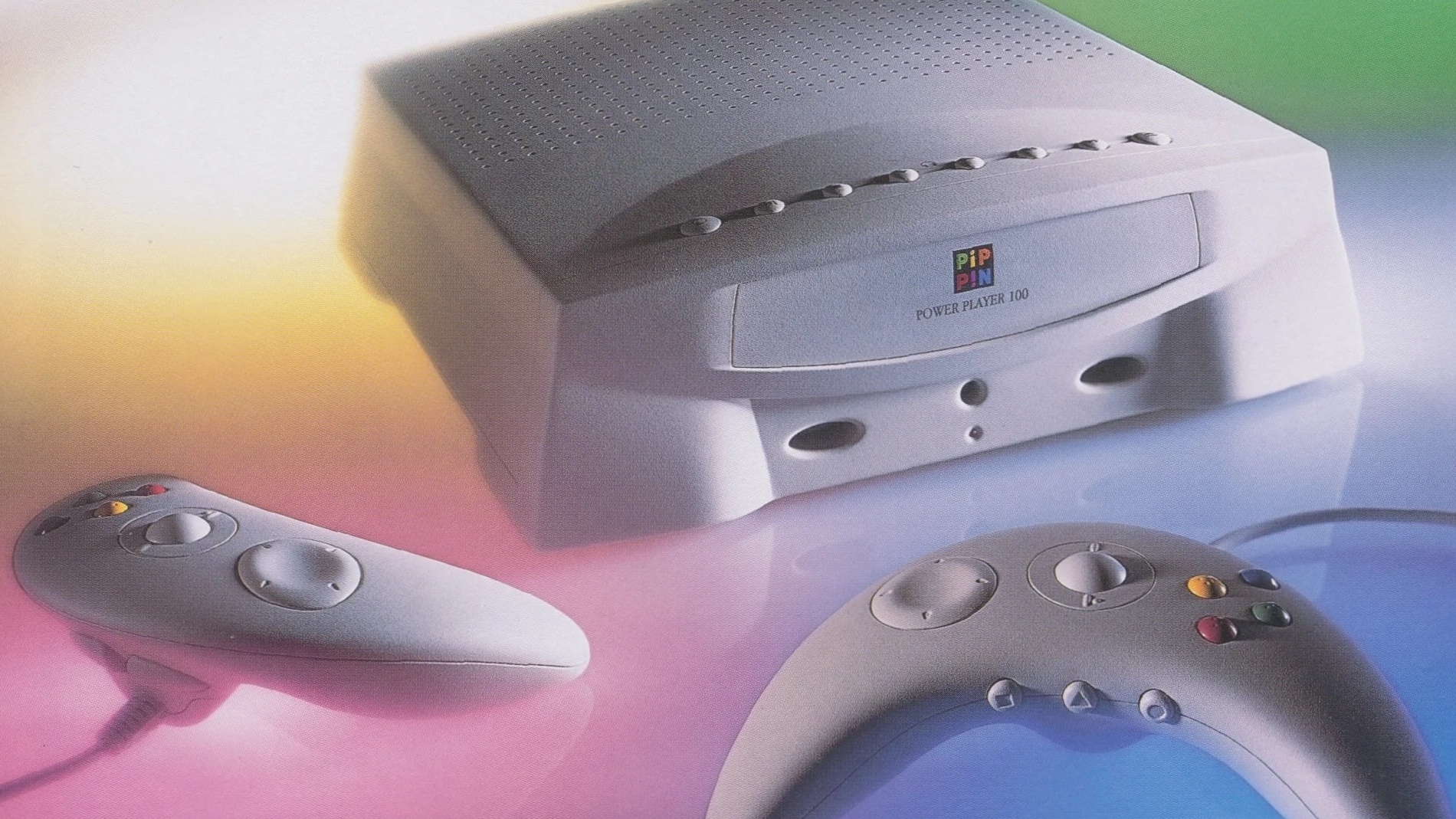
In 1996, Bandai teamed up with Apple to create a device that would somehow be a computer, a game console, and an internet appliance all at the same time. This ambitious fusion was the Bandai Pippin, a system powered by stripped-down Macintosh technology and priced like something meant for corporate training rooms rather than kids who wanted to play games.
The Pippin was built around a PowerPC CPU, a CD-ROM drive, and a bare-bones version of macOS. The idea was simple: Apple would license the platform, Bandai would manufacture the hardware, and third-party developers would create a new generation of multimedia titles. The marketing promised that the Pippin would bring interactive computing into the living room, but the reality is that almost nobody understood what the device was supposed to be.
It launched at around $600. That price placed it above the PlayStation, above the Nintendo 64, and above many entry-level desktop PCs. For that money, buyers received a machine that performed like an underpowered Macintosh from two years earlier. Even worse, many early titles were just Mac software repackaged into Pippin boxes. In some cases, the same programs were available for Macintosh computers that were cheaper and far more capable.
The controller was an oval-shaped hybrid of a gamepad and a mouse. It looked futuristic but felt awkward. Cursor-driven interfaces were a poor match for games and a worse match for the living room. The system supported dial-up internet, which would have been impressive if home computers were not already doing the same thing more efficiently.
The library never took shape, and depending on how collectors count regional variants, the Pippin had fewer than a hundred titles, and only a fraction were actual games. The rest were educational discs, business software, reference media, and interactive storybooks. Bandai invested heavily in the Japanese launch, but local consumers gravitated to the PlayStation while schools and offices purchased actual PCs. The US launch was even smaller, lost in the shadow of established platforms.
Apple showed little long-term interest in the project, as this was at the tail end of the company’s chaotic licensing era, a period marked by inconsistent leadership and hardware experiments that never found markets. When Steve Jobs returned to Apple in 1997, the licensing program ended instantly, and the Pippin was cut off and left stranded with no future support.
Within a year, Bandai stopped producing the system, retailers discounted remaining stock, and the Pippin faded almost immediately into obscurity, remembered only as a symbol of Apple’s most directionless era and Bandai’s attempt to blur the line between console and computer without offering the strengths of either.
Today, the Pippin is a collector’s trophy. It is rare, expensive, and historically important precisely because it tried to predict a multimedia future that never happened. It failed, but it failed with the kind of misplaced confidence that makes retro hardware endearing.
What did you think of this article? Let us know in the comments below, and chat with us in our Discord!
This page may contain affiliate links, by purchasing something through a link, Retro Handhelds may earn a small commission on the sale at no additional cost to you.
