

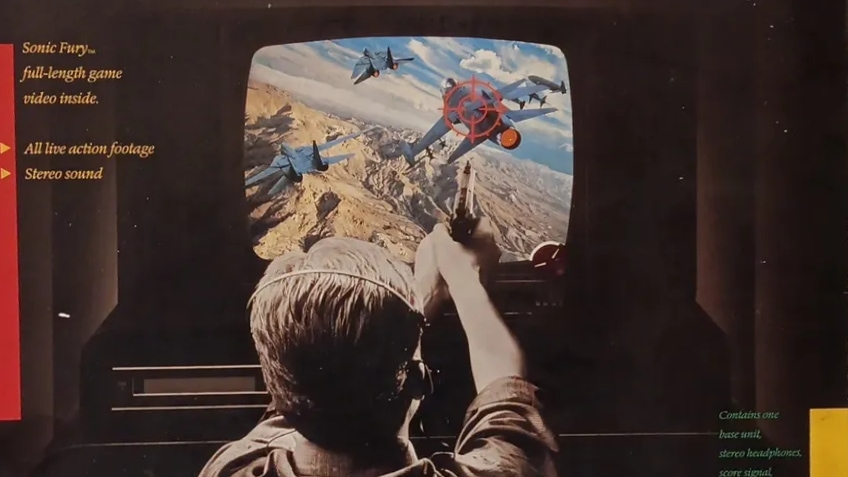
The Action Max arrived in 1987 as one of the stranger responses to Nintendo’s world domination. Worlds of Wonder, a toy company founded by former Atari executives, had already proven itself capable of identifying hits with products like Teddy Ruxpin and Lazer Tag. They’d even served as the original retail distributor for the NES during its crucial 1986-1987 North American launch period, giving them front-row seats to Nintendo’s conquest of the market. Instead of foolishly building a traditional console to challenge the gaming giant they’d helped establish, they released a VHS-powered light gun system.
The hardware itself was straightforward: a control unit with an LED scoreboard, stereo headphones, a light gun, and a pack-in copy of Sonic Fury, all for just under a hundred smackers. To parents surveying the gaming landscape in late 1987, that price point looked considerably more attractive than Nintendo’s offerings, and the live-action graphics certainly appeared more sophisticated than anything involving Italian plumbers. Setting up the system required connecting it to your VCR’s audio output and positioning a sensor with a suction cup on your TV screen. The whole contraption ran on four C batteries or an AC adapter and featured volume and sensitivity dials on top.
The Tech Behind the Trick
The Action Max wasn’t actually a game console in any meaningful sense. It was a scoring device that watched the same tape you were watching. The system used two sets of flashing white spots to determine hits: one reference spot where you placed the sensor on your screen, and another on enemy targets. When you pulled the trigger, both the gun and the sensor would look for flashing white areas. Enemy targets flashed in sync with the reference spot, while friendly targets flashed opposite to it, allowing the console to track hits, misses, and friendly fire.
The console offered a “reflex” scoring mode that used the constant master sensor to detect exactly when targets appeared on screen, awarding more points for faster reaction times. None of this changed the fundamental problem: the video played identically every time, with no branching paths or player agency. You were shooting at a predetermined sequence that would unfold whether you hit anything or not.
A Handful Of “Games”
Only five cassettes were released for the Action Max: .38 Ambush Alley (a police shooting range), Blue Thunder (based on the 1983 movie), Hydrosub: 2021 (a futuristic underwater voyage), The Rescue of Pops Ghostly (a comic haunted house adventure), and Sonic Fury (the pack-in aerial combat title). Each cassette included playable previews of other games at the end, an early example of game demos that showed some forward thinking.
The entire VHS gaming concept was a technological dead end. Other companies would later experiment with more sophisticated approaches using complex branching video paths, eventually leading to full-motion video games like Night Trap on the Sega CD. Worlds of Wonder deliberately chose the simplest possible implementation to keep costs down, banking entirely on the novelty of shooting at live-action footage rather than developing any meaningful gameplay depth.
Be Kind, Rewind
By September 1987, Worlds of Wonder was already drowning in nearly $240 million of debt. The company had catastrophically overestimated demand for Teddy Ruxpin while underestimating the NES, creating a massive financial shortfall. Their 1986 Lazer Tag launch had been undermined by late shipments from Hong Kong suppliers that missed the crucial Christmas window, leaving retailers stuck with unsold inventory. The Action Max launched directly into this chaos, and by December 1987, the company had fired nearly half its workforce and slashed prices on remaining stock.
The broader toy industry wasn’t helping. Sales across the sector were flat, and consumers were rejecting expensive electronic toys in favor of traditional products like Barbie and G.I. Joe. A $100 VHS gaming system that required additional hardware and offered zero replay value stood no chance in that environment. Worlds of Wonder filed for bankruptcy protection in 1988, with creditors operating the company in receivership until finally closing in 1990.
This is where most Game Over stories typically end, but as it turns out, the Action Max story has a post-credits scene. As recently as 2018, homebrew tapes were still being made for the system. Will there ever be a true revival? Almost certainly, no. Still, in an era where we can’t even be certain if our games are made by real people, it’s reassuring to see something so unmistakably human.

1 Comment
Awesome technology…and another reason why game preservation is so important