


If you scrolled through tech news media over the past week, one of the hottest and most infuriating issues that made its way to the forefront of almost every outlet was a recent March 2026 system update for the PS5 that added a form of digital rights management (DRM) to all new digital purchases. At the time, it forced every new digital purchase into a mandatory license check-in after 30 days, effectively requiring you to always be online to access your digital library.
As expected, this revelation sparked outrage over what is yet another stab at digital ownership from large corporations. Ironically, Sony poked fun at the Xbox One’s always-online and DRM-heavy nature to the point where it became the best advertisement for the PS4 (Xbox later changed its mind, but the damage was done). Sony has finally responded, and we can finally breathe a sigh of relief.
What Does This Update Do?
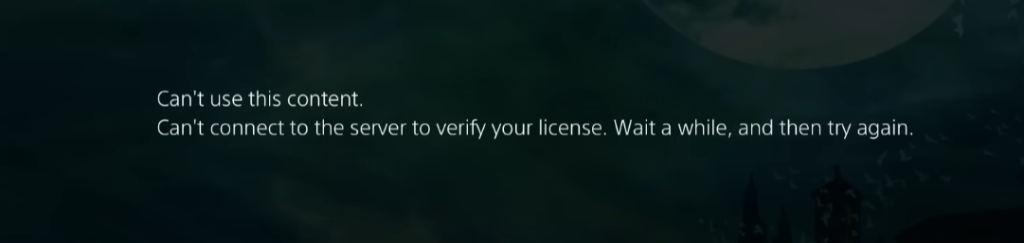
YouTuber Spawn Wave did a thorough breakdown in this video where he tested the update to see exactly how it behaves between older digital purchases, newer digital purchases, disc-based games, and offline/online use for a PS5 that is the primary console. He determined that older digital purchases will work as expected offline and online, with no DRM checks, while only newly purchased games will require an online check-in after 30 days. If you miss your 30-day window and your console is offline, the newly purchased game will not boot. Disc games aren’t affected by this update.
The PS5 uses a CMOS battery (similar to an NES or Game Boy cartridge) to keep time and other system settings, and is also used to validate licenses based on that data. Removing the battery effectively resets those settings, requiring any DRM licenses to be validated on boot, which also kills booting new games offline.
Up to this point, the PS4 and 5 were traditionally liberal in allowing games to be played offline, with even disc-based games being able to be installed and played completely offline (which is still valid except for download-required titles or, most recently, Crimson Desert), so this was a major letdown.
Sony’s Response: It’s Not AS Bad
In a response issued to Gamespot on 4/29, Sony clarified that the 30-day check-in on new titles is a one-time occurrence that takes place after 30 days to convert the title to a permanent license, which is notably past the game’s “refund” period (Good luck getting a refund from Sony for anything digital) of two weeks.
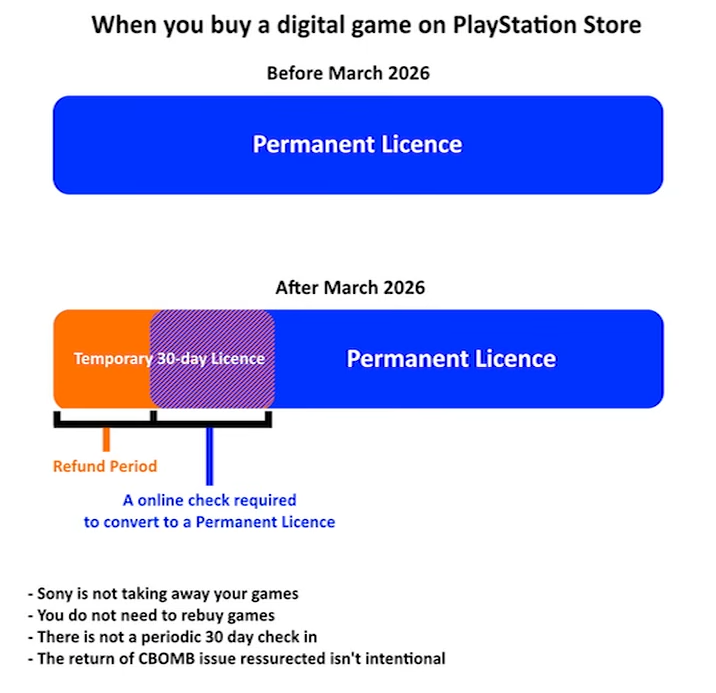
This makes sense since existing digital purchases will fall outside that policy period, even if the game isn’t 30 days old yet. In short, your games will retain a permanent license after a 30-day check-in. Your digital purchases will be fine online and offline.
Conclusion: Are We Happy With This?
Ideally, we want to own our digital purchases in the same way we have physical media. History and policy show that this just isn’t the case. In a world where DRM is getting tighter and digital distribution is dependent on having active servers, the expectation that you own your digital purchases is nearly moot unless you actively have the game files on your open system and DRM is removed, like with GOG and Itch.io purchases.
Steam, Nintendo, Sony, Xbox, Epic, etc. have adopted the “Limited License” policy to allow people to legally purchase something and the company/publisher to still maintain control over it. Limited Licenses are common in the art/media world and are used to protect the creator/copyright holder’s assets.
I’m an architect, and when you contract us to produce drawings necessary to build a building, we grant a limited license to the owner/contractor to use our drawings for construction. This arrangement means we still own the drawings, own the CAD files, and legally bind the owner to use them as directed.
It’s a messy situation with video games since you can’t exactly have someone play your game without giving out your assets, so DRM is used to control how their games are played and collectively annoy us.
“But Joeee, why are you defending this policy? If buying doesn’t mean owning, then piracy isn’t stealing right?!?”
My actual opinion on this is as follows (Also, I only buy physical if I can).
