

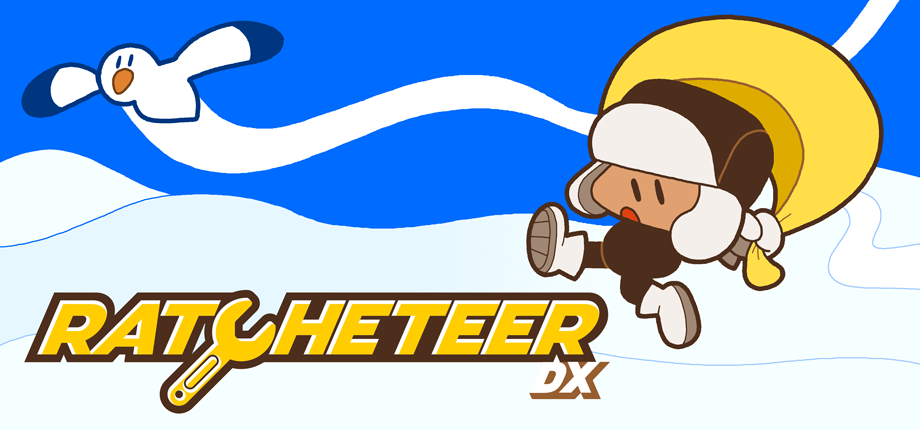
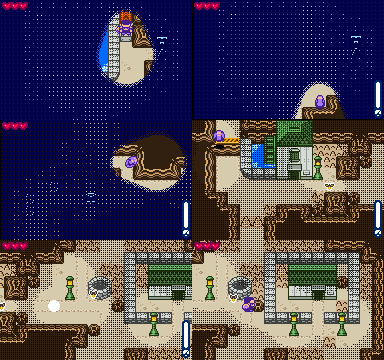
It is hard to write an intro for an artist you admire, let alone one you consider a friend, but here goes: Shaun Inman makes things. From chiptune music, to custom firmware, to games, and a game engine for the little yellow marvel called the Playdate. One of those games, 2022’s Playdate Game of the Year Ratcheteer, is getting the DX treatment and heading to the Nintendo Switch, Steam, itch, and the Mac App Store on March 5th, in full color.
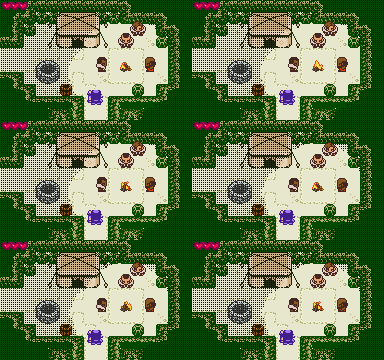
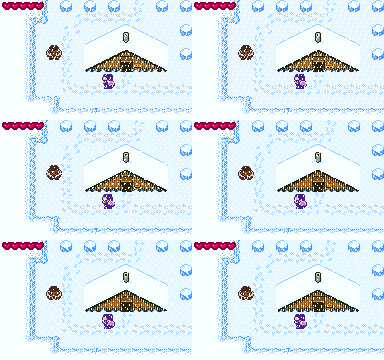
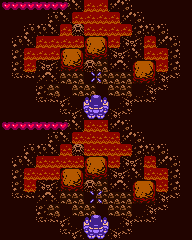
The game is truly something special, with engaging gameplay, gorgeous pixel art, and a stunning soundtrack by Matt Grimm (8bitmatt). There is a demo of Ratcheteer on Steam right now, where the game is described as “a lo-fi, top-down, action-adventure” and takes place in a vast underground cavern system beneath a frozen, post-apocalyptic landscape. You’ll master various tools to traverse “more than 250 rooms across 6 regions and 6 dungeons”.
The DX version features enhancements like the ability to swap color palettes (Color, Pea Soup green, Playdate gray, or high contrast black-and-white) and add optional scanline, grid, and dot overlays. It’ll also feature a CD-quality version of the aforementioned soundtrack.
Hit the Steam page here to check out the demo and add the game to your Wishlist. I had the chance to talk with Shaun about Ratcheteer DX, the evolution from its Playdate origins, and what goes into making something truly special. Check out what he had to say below!
J: Ratcheteer is a game that was designed with the Playdate’s hardware in mind. At what point did you realize you wanted to expand on the idea?
S: As something that was fully conceived and designed around the constraints of the Playdate (the black and white screen, the importance of light, both in and out of game, and the limited and novel input method) I had never really considered bringing it to other platforms until one day Cabel asked if I’d be interested in porting it to the Switch. As a child of the 80s weaned on NES, Game Boy, and Super NES games, releasing something on a Nintendo console is a dream come true.
J: In its original form, the game uses negative space and a stark art style to convey a sense of claustrophobia. Were you concerned about the game losing any of that atmosphere in the transition to color and a larger display?
S: It was definitely a consideration, but I wouldn’t say it was a huge concern. The Playdate’s widescreen aspect ratio was something I already had to contend with, and the Crank Lantern’s view-limiting cone-of-light functions similarly in color. The optional overlays added in this release also help break up flat spaces where adding detail to the art wasn’t really warranted.
J: Conversely, was there anything that was easier to get across or accomplish with more computational resources and a larger color palette?
S: Volume! In addition to the limited palette, the original game uses a non-standard 12×12 tile size, so proportions and scale more closely match the Game Boy look I was going for. (8×8 was too small and 16×16 too big. The game’s internal resolution is 192×120, so this tile size allows for a more Game Boy-like 10 rows of tiles on screen instead of 15 or 7.5.) This pair of constraints made communicating contour and shape very challenging; black and white were doing double-duty, having to define the silhouette and the three-dimensional form.
J: What was the very first mechanic or moment you prototyped that made you think, “Okay, there’s a real game here”?
S: I think it was probably the test dungeon I threw together early on after implementing all the different abilities. It was condensed, but the sense of progression from acquiring each tool felt great. Jumping around, drilling through walls, dashing over rails, it was just fun to move around. The dynamic darkness mechanic, vision being limited to the light cast by the lantern, but still being able to see highlights of interactive elements, also felt really interesting.
J: Did you ever cut a mechanic or dungeon idea that you loved but just didn’t fit? What was it, and why did it die?
S: Early on, the game had Bell Doors, doors with an image of a bell on them. Elsewhere in the room would be an actual bell. But you couldn’t hit it by just slashing; you had to jump and slash to ring the bell, which would open the door.
At that point in development, you still had to manually switch between the jump and slash tools mid-air so it felt too finicky for what was essentially just another type of key. There was also a cut enemy type that would fire projectiles you could deflect back by spinning the drill shield, but I could never get that feeling good in an actual room, so it was abandoned.
J: Ratcheteer leans on player curiosity in a way that feels very old‑school. How do you think about respecting players’ time while still allowing for that sense of being a bit lost?
S: Every creation is a reaction to something. At the time, I was fed up with games leading with handholding and tutorializing. So I tried to minimize exposition throughout, rendering NPCs more as archetypes than characters. Beyond core beats and literal directions from NPCs, most of the story is tucked away in books and clippings.
These can largely be ignored, but with the optional Hand Lens tool enabled, icons appear over points of background interest and NPCs who have something new to say since the last time you spoke to them. Then there are just modern quality of life things, like the map marking the next destination along the golden path. So direction is there for those who need it, but the game is never in your face about it.
J: What did the Playdate’s constraints teach you about your own design instincts that you carried into the expanded version? Is there anything the original hardware forced you to do, like technical hacks, or design workarounds that you ended up intentionally recreating in the new version because it just felt right?
S: I think it just reinforced that I really like constraints. If I could do everything, I wouldn’t do anything. That’s just too blank a canvas to even know where to start. Black and white screen? That eliminates a whole swath of possibilities. Limited inputs? The possibility space gets even smaller. But the more you zero in, the more you become aware of details you never noticed before.
It’s like Twitter, good Twitter, the one with the 140-character limit. Constraints force you to hone an economy of expression. Like earlier, I mentioned black and white doing double duty, defining both the silhouette and the volume of an object. Or overloading an input, like tapping B to swap tools or holding it to open a menu to change out your current tools.
On the technical side, this game was originally programmed in Lua, but since it was my first time using the language, my code just wasn’t performant on the hardware. The garbage collector became my enemy. After fighting with it for a while, I decided to port to C. But I don’t really love C and didn’t have much experience with it for larger projects. Especially for something like a game where object-oriented programming best fits my mental model.
So I created a superset of C that adds support for classes, inheritance, inline functions, callbacks, doesn’t require redundant header files, and interoperates with vanilla C. Which is like a totally normal thing to do, right? But this made porting to PC and console really simple because in the end, it’s just C and C compiles everywhere.
J: How did early feedback from the Playdate community shape the direction of the expanded version, if at all?
S: I think the biggest hurdle for players of the original game was tool switching. Auto-switching helped, but wasn’t always obvious when or even that it was happening at all (eg. If you use the jump tool when an offensive tool is in the secondary position, it will switch into the primary position for the duration of the jump, so you can act with the same button that initiated the jump).
Keyboards and modern controllers have buttons to spare, so in the port, each tool gets its own dedicated button. Other bits of feedback focused on difficulty and an in-game economy. The port adds a new ration system to help address those concerns.
J: The game obviously pays homage to the classic Zelda games, down to the new title recalling the full color Link’s Awakening DX. What other games share DNA with Ratcheteer?
S: While Ratcheteer is not an RPG, the early Final Fantasy games have definitely informed how I tell a story. NPCs often have more than one thing to say and may react to events as they unfold. I was always fascinated with the second half of VI. You effectively game over at the midpoint, and then the rest of the game is basically the bad ending. The idea of having the worst come to pass and finding a reason and means to push through really stuck with me.
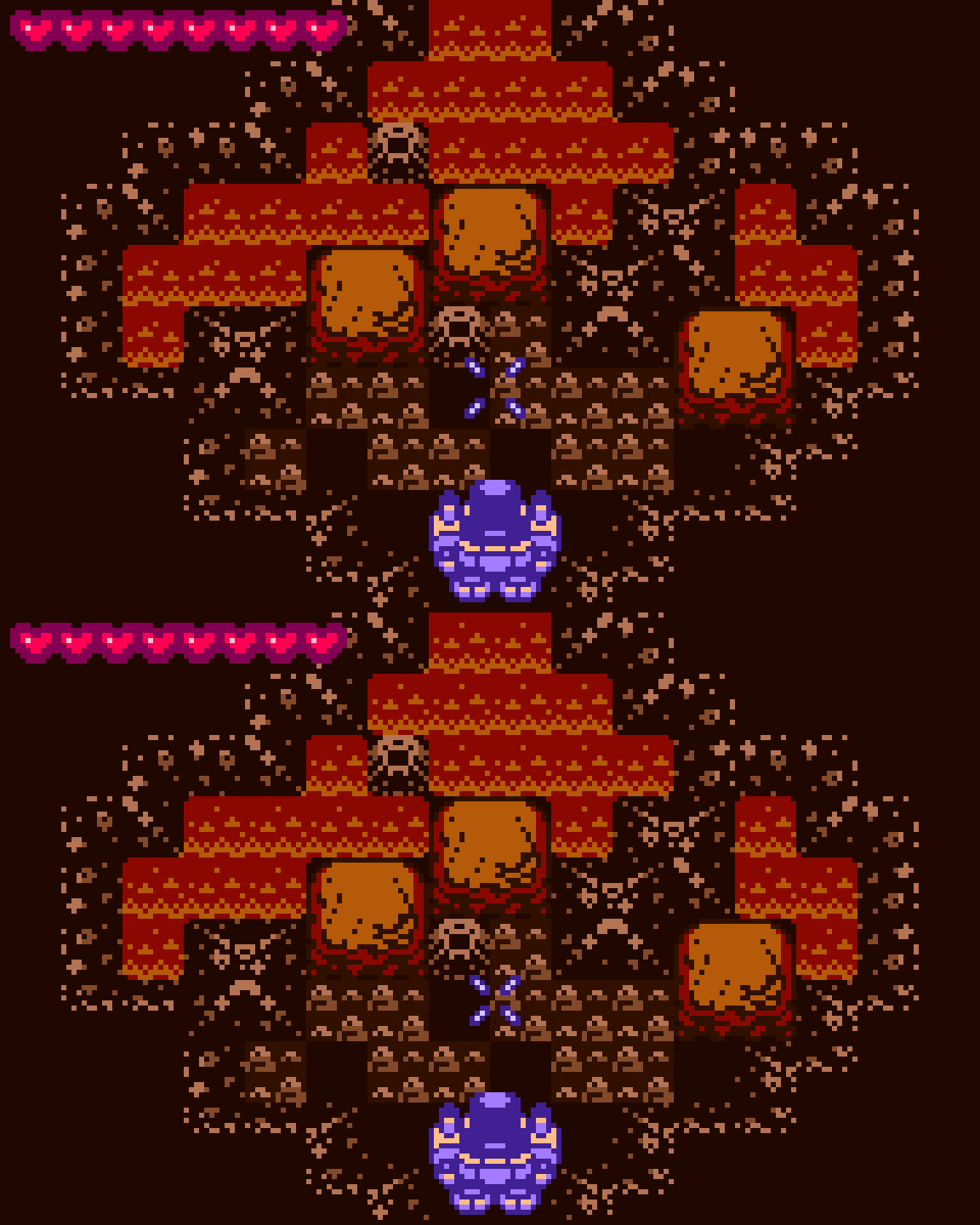
Gameplay-wise, Final Fantasy X‘s Al Bhed language inspired the game’s Astral language. Beyond the common mechanical DNA the Zelda and Metroid series share, there are also some more overt references to the latter in the form of the Hand Lens, Roll Armor, and the location and nature of the final encounter. The Drill Shield was inspired by the Game Boy Advance gem Drill Dozer (from Pokémon creator Game Freak). And the darkness mechanic was inspired by an old Ludum Dare jam game I made called Sinkhole.
J: What’s next for you? A Ratcheteer sequel? A new Playdate game? A Pulp demake? MaxUI for people who prefer tinkering to actually playing their retro games?
S: Let’s see. I’m always prototyping a new Playdate game. I have a spiritual sequel to Word Trip in the works that should be out later this year. But no, no Ratcheteer sequel or demake. I can’t really talk about other Panic things on the horizon, but having retired MinUI, I am tinkering with a new, even more focused and more limited custom firmware (if you can believe it).
J: When players finish Ratcheteer, what is the one feeling or idea you most hope sticks with them?
S: Hmm. I don’t know. Ratcheteer isn’t really telling an especially profound story. While making it, I was thinking about found-family, respecting others’ right to choose for themselves, embracing refugees, and the terminal feedback loop of isolationism and extremism.
Mechanically and thematically, Ratcheteer is a game about casting light into the darkness and coming away with a better understanding of the things in your orbit, be it an environmental puzzle or a perceived threat, working from their own incomplete understanding of a situation.
So maybe the music, Matt really knocked it out of the park.
J: Ratcheteer is part of a small but passionate ecosystem around the Playdate. What do you think the community understands about games that the larger industry may miss?
That you don’t need the polish of a Hollywood blockbuster to have fun. Those constraints, even self-imposed, can lead to innovative mechanics and art styles. That a console that is also a dev kit with a super approachable SDK can draw from a wider pool of talent, leading to unique perspectives and ideas.
There’s something genuinely endearing about being able to create for, not just consume on a console. You put a little piece of yourself into it, and it becomes a part of you. I think that’s why the Playdate community is so passionate about it.
J: Was there a piece of advice about game development that turned out to be wrong for you, or that you had to unlearn while making Ratcheteer?
S: I don’t know if I ever received this as advice, but even now, I tend to think in terms of building the tools or systems first, then filling them with content. But there’s never a clear delineation between pre-production and production in my experience. The level editor evolves over the course of development because the gameplay evolves over the course of development. One informs the other. When you lock in your tools early, the gameplay suffers for it.
J: When someone looks back at Ratcheteer ten years from now, what do you hope they say about it?
S: The biggest compliment would be someone unfamiliar with retro gaming picking it up on a modern storefront and having it be their entry point to the classics that inspired it. That and maybe marveling at how low the any% time has gotten. I love the passion and ingenuity of speedrunners, and it would be an honor to have a game outlive its commercial viability because of bugs and clever misuse of intended mechanics.
J: Before I leave you, any parting words or shout-outs?
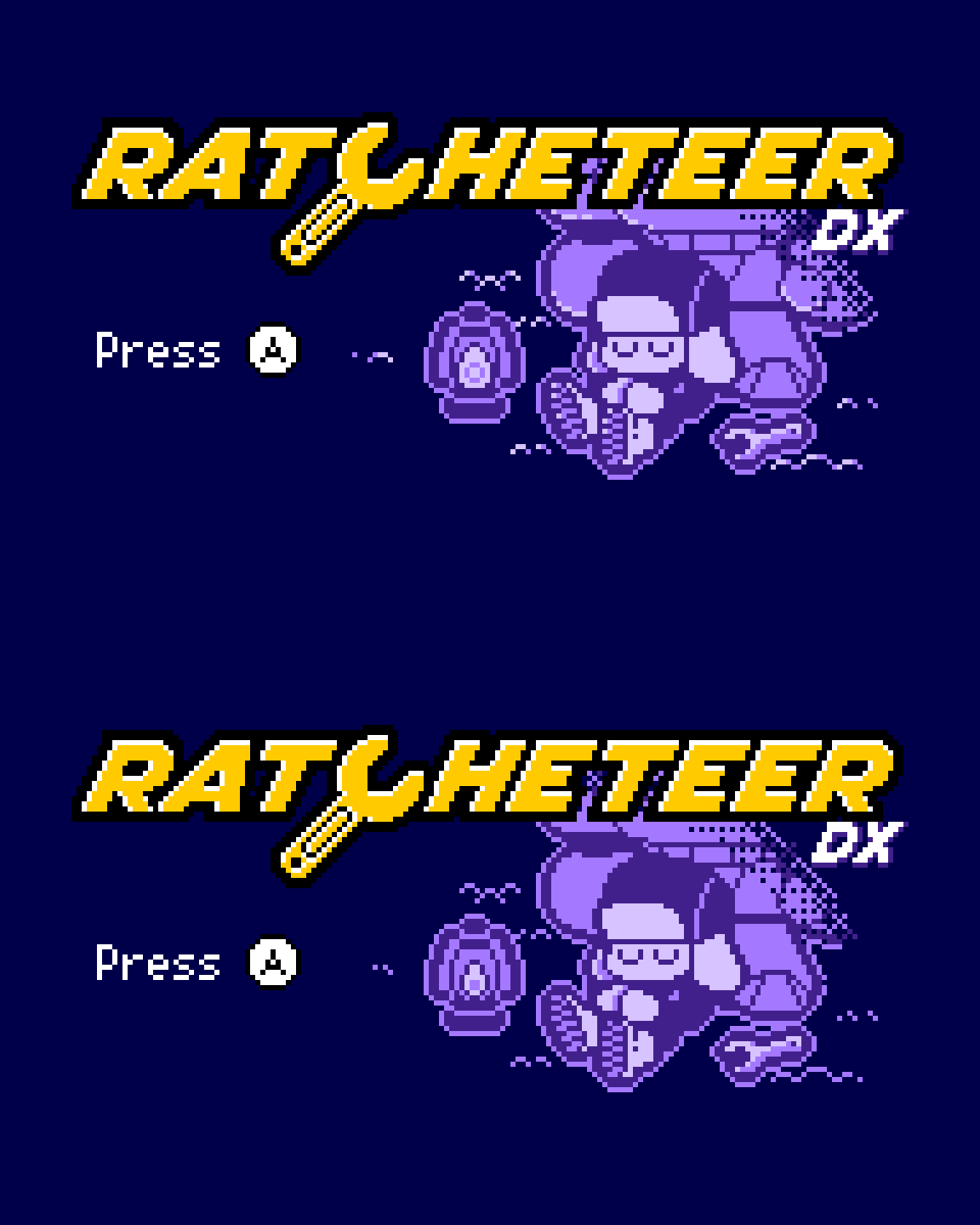
S: Yeah, man, thanks for reaching out! I hope everyone will check out the game when it drops on March 5th for Nintendo Switch and Steam. (Germane to the RH community, Gamma had the Steam demo running via GameHub Lite on an RG477V, so these handhelds are another avenue for play.) And I definitely need to shout out Matt Grimm, who did the music, and Charlie Davis, who did the title screen and ending illustrations. And finally, the team at Panic. Making a game is one thing, publishing a product is a whole other, and honestly, I probably wouldn’t have the patience for it on my own.
Ratcheteer DX hits Nintendo Switch, Steam, itch, and the Mac App Store on March 5th, and whether you’ve played the Playdate version or are discovering it for the first time, this is one underground adventure worth exploring. Thanks to Shaun for taking the time to answer my questions!
What did you think of this article? Let us know in the comments below, and chat with us in our Discord!
This page may contain affiliate links, by purchasing something through a link, Retro Handhelds may earn a small commission on the sale at no additional cost to you.
