

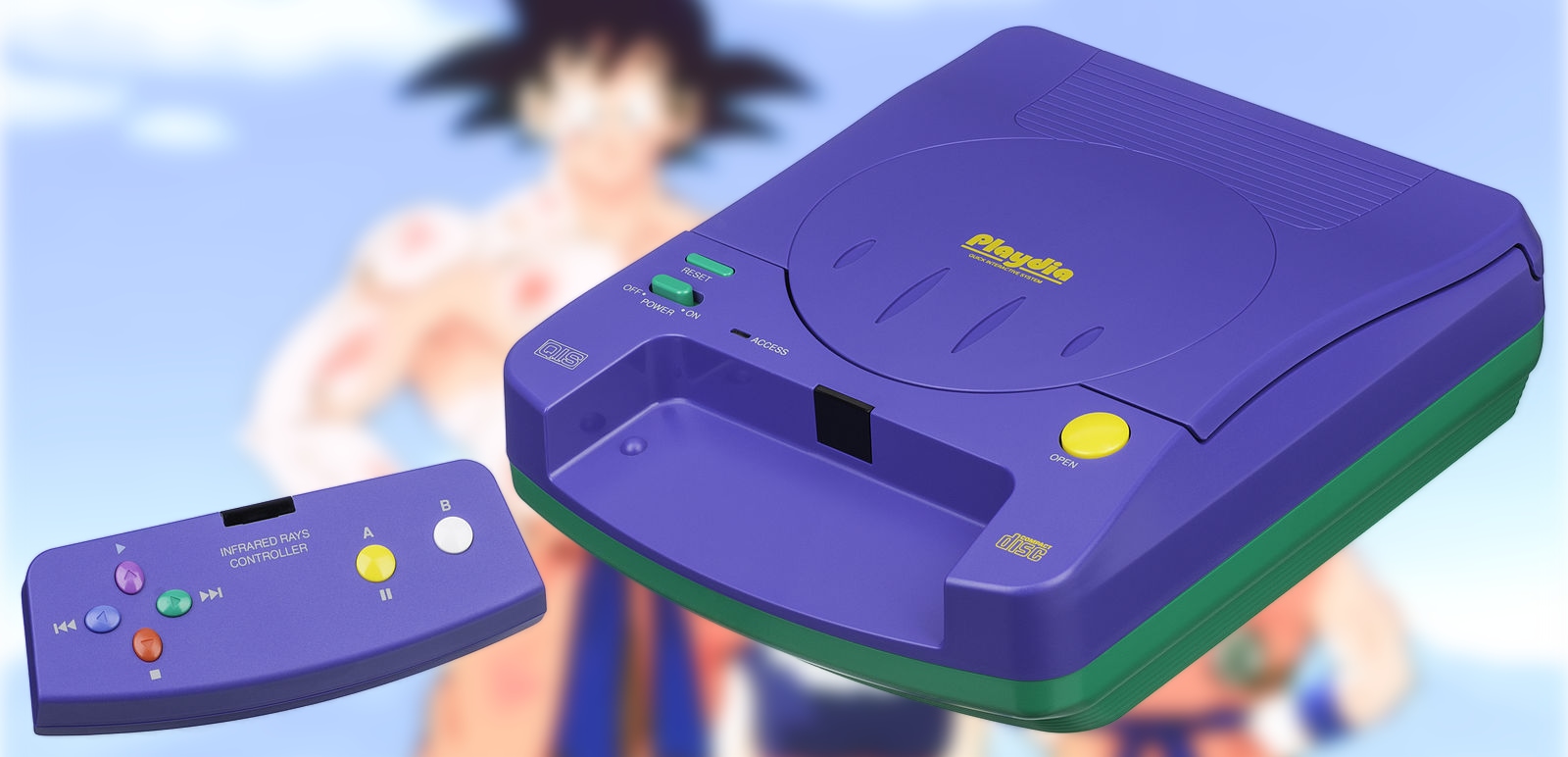
In September 1994, Bandai, masters of toy licensing and mid-budget anime tie-ins, decided they were done competing with actual game consoles. Nintendo had the Super Nintendo, Sega had the Genesis, and Sony was sharpening its knives for the PlayStation’s launch. Bandai? Bandai said, “What if, instead of games, we made a children’s FMV machine?”
Enter the Bandai Playdia Quick Interactive System, a tiny blue lunchbox-shaped console that proudly advertised “interactive multimedia” at a time when “interactive multimedia” usually meant a beige CD-ROM drive and a stack of Encarta discs (remember the dungeon-crawling trivia game on those?).
The Playdia came with a wireless infrared controller, which was less “cutting-edge console innovation” and more “TV remote with delusions of grandeur.” The whole device felt designed for a child who wasn’t allowed within six feet of a real gaming system. Huge buttons, toy-like build quality, and enough battery compartments to qualify as a choking hazard.
The hardware underneath was underwhelming even by mid-’90s standards. No real sprite engine, no polygons, no scrolling backgrounds. The only thing the Playdia did reliably was play full-screen FMV clips, which formed the basis of its entire library. Every title followed roughly the same structure:
- Play an anime video.
- Stop video.
- Ask the player to press A or B.
- Resume video.
Sometimes pressing the wrong button caused Goku to look slightly confused. Occasionally, there would be a rudimentary 3D hallway to walk down (below). That was about as deep as it got.
Its catalog reads like a fever dream of Bandai licensing: Dragon Ball Z, Sailor Moon, Ultraman, Gundam, Kamen Rider, plus educational discs that attempted to teach children math through the sheer power of awkward mid-’90s animation. If you ever wanted to watch a branching-path DBZ episode where “Left” and “Right” are somehow moral choices, the Playdia has you covered.
But not even Japan’s insatiable love of character goods could save it. The Playdia arrived just months before the PlayStation and Saturn ushered in the age of 3D gaming, leaving Bandai’s cheerful blue box feeling like it was built to survive a world that no longer existed. Kids didn’t want interactive FMV quizzes when Sony was offering 3D explosions, and Sega was shouting about blast processing one last time.
Sales fizzled and support quickly dried up. By 1996, Bandai quietly ushered the Playdia into the great toyroom in the sky, where it now rests next to the LaserActive, Pippin, and whatever the hell Casio was making that year.
And yet, the Playdia has earned a soft spot among collectors. It’s undeniably charming. It’s colorful and weird. It’s one of the few consoles where Sailor Moon teaches preschool logic puzzles, and Gundam lectures you about its own lore through FMV slideshows. It failed, sure, but it failed with style.
Like so many devices we’ve covered, the Playdia never stood a chance, but at least it went out glowing brightly in 15 frames per second.
What did you think of this article? Let us know in the comments below, and chat with us in our Discord!
This page may contain affiliate links, by purchasing something through a link, Retro Handhelds may earn a small commission on the sale at no additional cost to you.
