

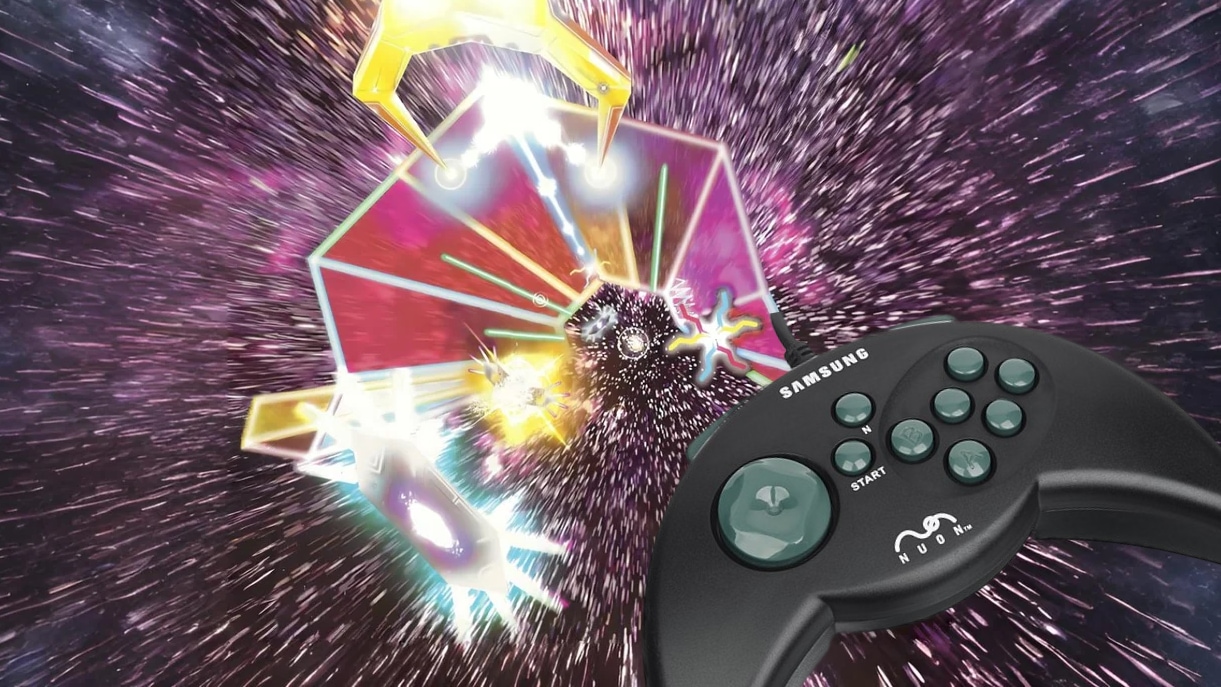
At the dawn of the new millennium, several companies all independently asked the same question: “What if your DVD player could also play video games?” Most companies wisely kept the idea hypothetical; VM Labs went all in.
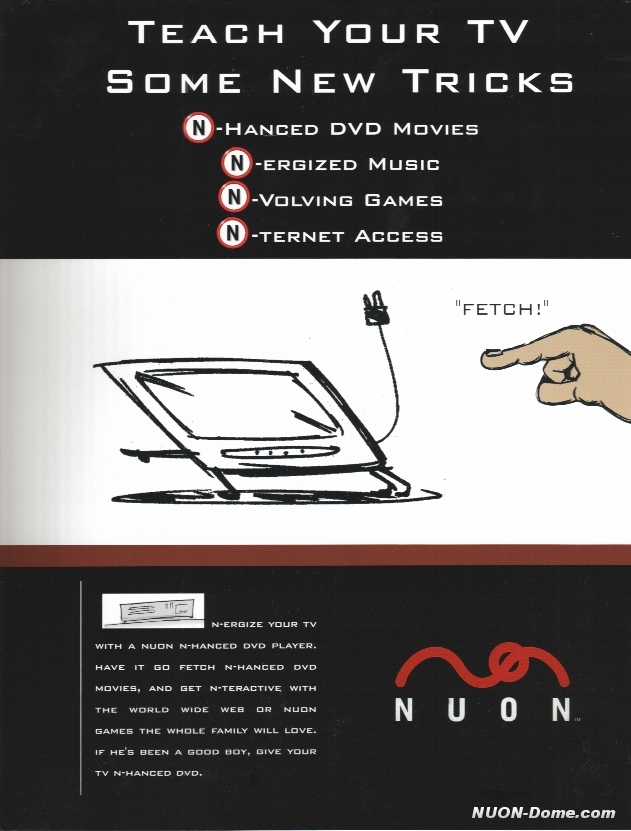
Thus emerged the Nuon, a “DVD enhancement technology” devised by ex-Atari engineers and licensed to manufacturers like Samsung and Toshiba. The pitch was simple: instead of buying a game console and a DVD player, why not buy a DVD player that was a game console? It was the kind of logic that made sense at CES after a long liquid lunch.
In practice, the Nuon lineup was a collection of perfectly normal DVD players that happened to contain an obscure, experimental RISC-based chipset capable of running software, if anyone ever bothered to write any. The problem was, they didn’t! Not much, anyway.
The Nuon launched in 2000 with an advertising strategy best described as “hope.” No mascot, no killer app, no unified hardware. Just a handful of DVD players with different buttons, different firmware, different feature sets, and a vague promise that, one day, games would arrive.
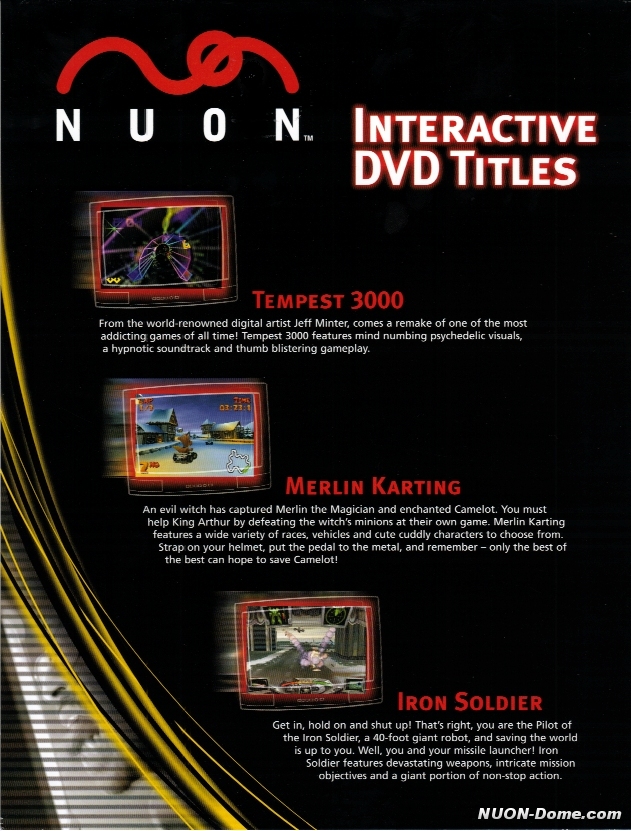
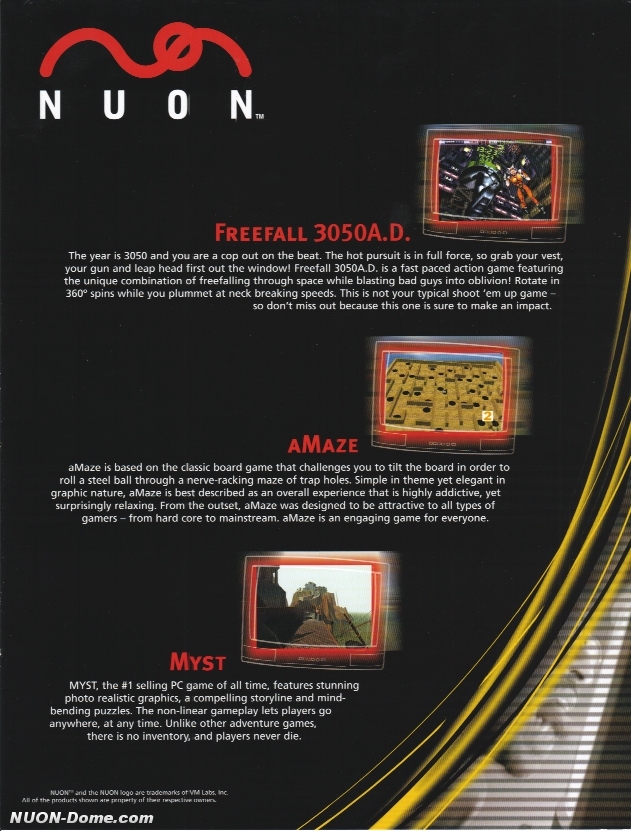
A few did. Eight, to be precise. (Time Extension actually breaks down all eight games in their excellent retrospective.)
- Tempest 3000 (Jeff Minter, bless him)
- Merlin Racing
- Space Ace
- Freefall 3050 A.D.
- Iron Soldier 3
- Ballistic
- The Next Tetris
- Crayon Shin-chan (Japan Only)
And to its credit, Tempest 3000 is genuinely excellent: a swirling neon masterpiece trapped inside a DVD player like a genie. But one great Jeff Minter game does not make a platform. The rest of the library ranges from “pretty okay” to “the kind of software you find pre-installed on an airplane seatback.”
The hardware situation didn’t help. Because every Nuon was technically just a DVD player, no two models behaved exactly the same. Bafflingly, not every model even supported games. Some had controller ports, others made you use the DVD remote. Even basic features varied; many Nuons (Nui?) couldn’t run certain games unless you bought a specific manufacturer’s edition.
By 2003, Nuon was already sputtering. DVD players had gotten cheap, and the PlayStation 2 had handily become the de facto DVD player for most of the planet. The Xbox had also just arrived with a built-in hard drive, real 3D power, and controllers that didn’t look like failed prototypes for universal remotes.
According to Ars Technica, the Nuon was actually well-received and had a fair amount of financial backing. Nonetheless, VM Labs shut down the same year. Some leftover Nuon units lingered in clearance bins, but finding a working one is just an eBay search away nowadays.
Collectors chase the Nuon out of curiosity, archivists chase it to preserve one of the strangest detours in the DVD era, and normal people don’t chase it at all, because normal people never knew it existed. The Nuon dreamed of blending home entertainment and gaming, but it was lapped by Sony’s contemporary market leader, and one great game wasn’t enough to save it from obscurity.
What did you think of this article? Let us know in the comments below, and chat with us in our Discord!
This page may contain affiliate links, by purchasing something through a link, Retro Handhelds may earn a small commission on the sale at no additional cost to you.

4 Comments
Before Nuon was commercially launched, it was called “Project X.” If you look in old EDGE and Next Generation magazines, you can see the big X logo atop a bloodied red Mario cap. Needless to say, it didn’t happen that way.
As I recall, there were only 2 Nuon-enhanced movie DVDs in addition to the games you listed. Banzai Buckaroo and Bedazzled.
Whoa, I love Buckaroo Banzai, I wonder what was added to make it “enhanced”. Thanks for yet another rabbithole!
Oh and that Tempest 3000 video isn’t just a low resolution capture. The game really was that blurry, it was meant as a feature not to see any pixels.
Hello, if you are who I think you are. This is very funny to me. Kinda like how lofi artists will crush stuff with fake tape noise to cover that they’re using low-bitrate youtube samples.