

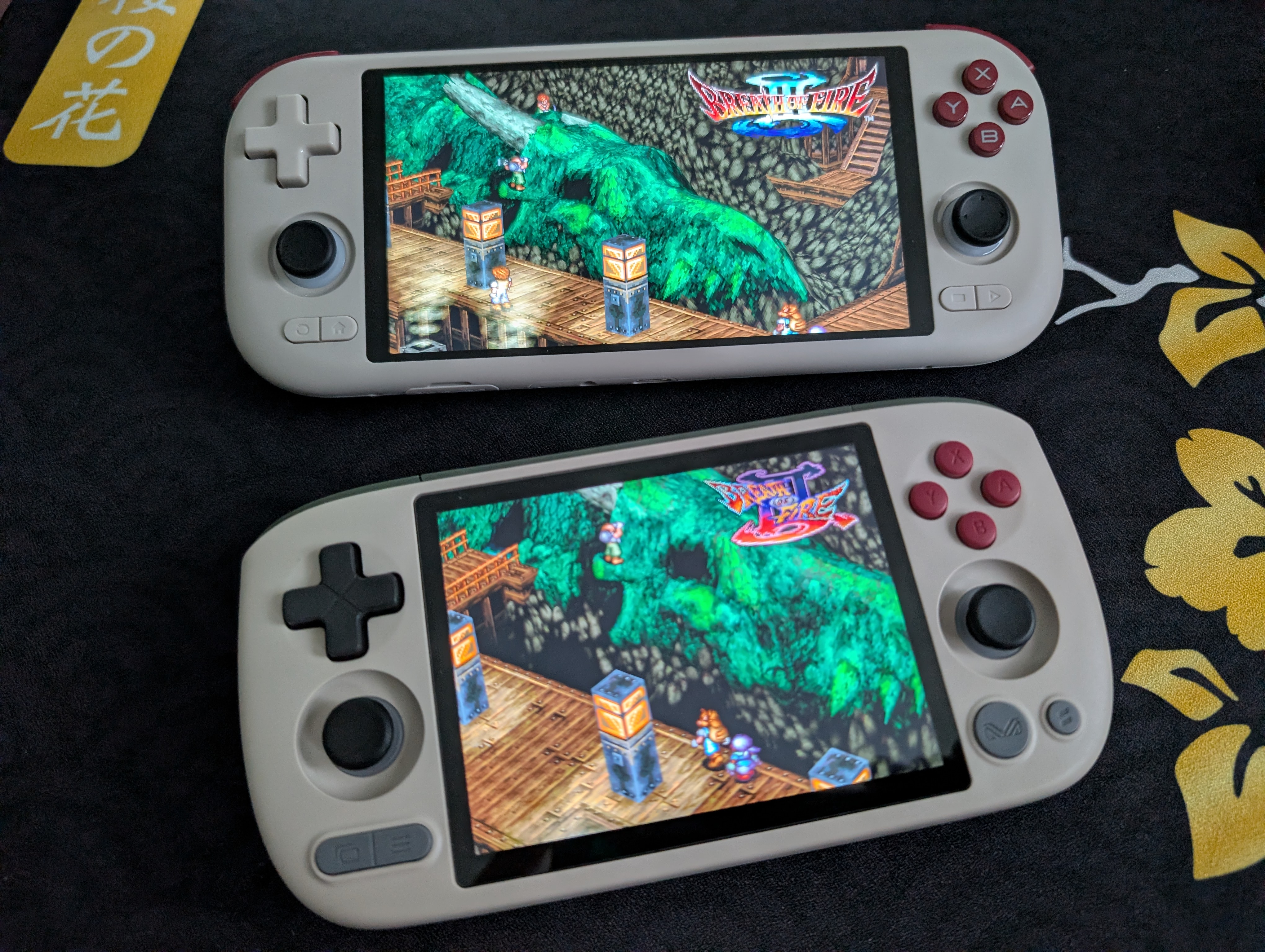
Mangmi and AYANEO have both recently come out with some absolute bangers in the sub-$100 retro handheld market. Having just gotten my hands on both the Mangmi Air X and the AYANEO Pocket Air Mini, it felt appropriate to take some time and compare these two budget handhelds.
Mangmi Air X vs. AYANEO Pocket Air Mini: Spec Comparison
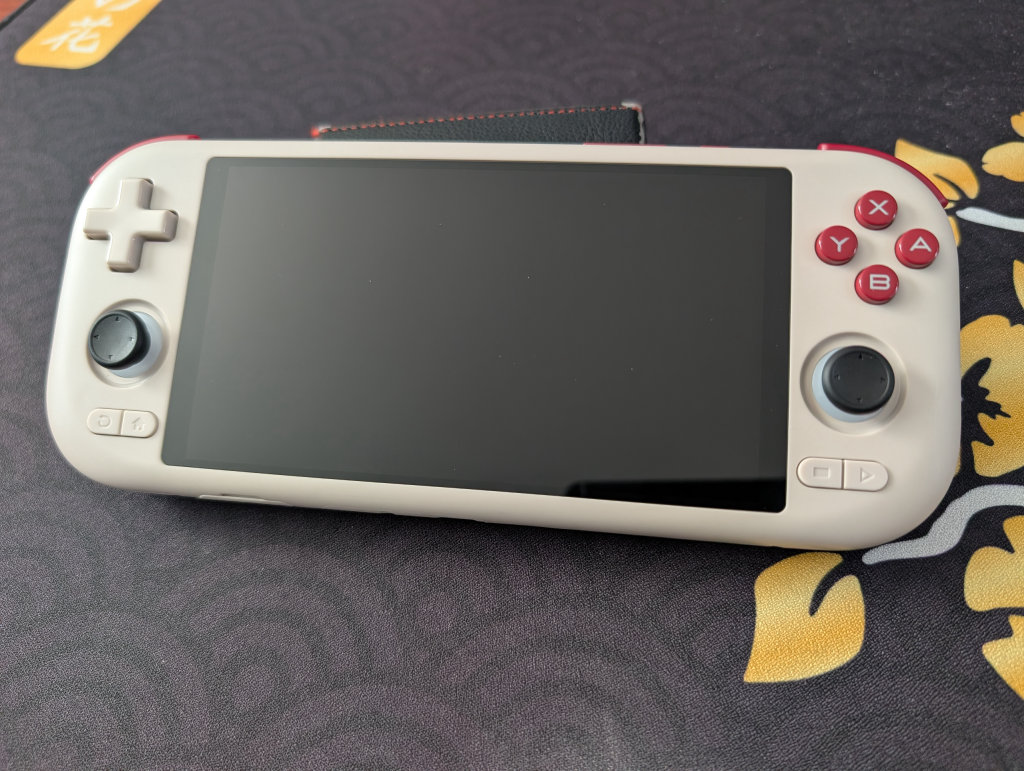
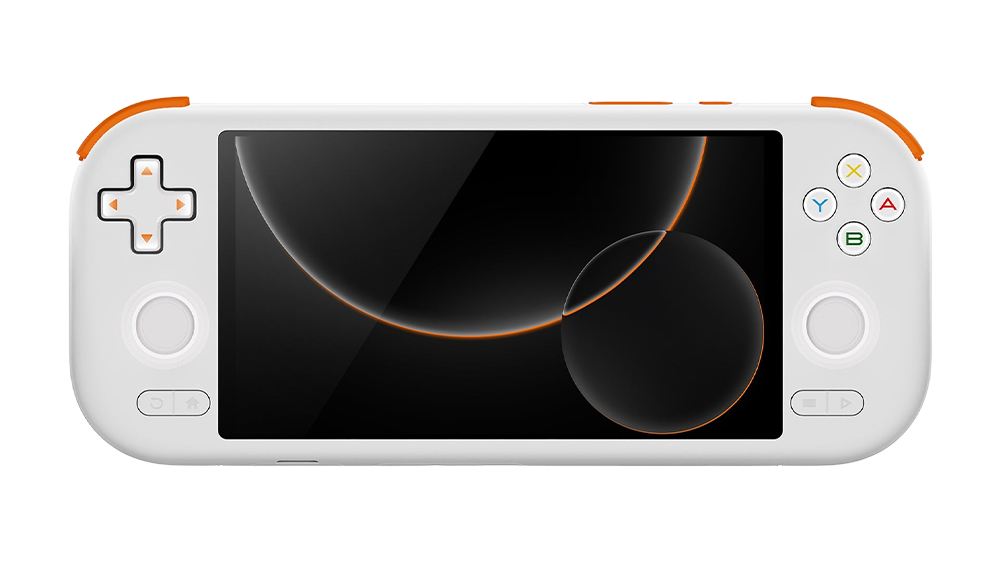
The Mangmi Air X has the following hardware specs:
- Display: 5.5″ 1920×1080 IPS at 16:9 aspect ratio
- CPU: Qualcomm Snapdragon 662
- GPU: Adreno 610
- RAM: 4GB
- Storage: 64GB
- Battery: 5000mAh
- Colors: White or Black
- Connectivity: USB-C, microSD, 3.5mm Audio Jack, Wi-Fi + Bluetooth 5.0
- OS: Android 14
- Dimensions: 203 x 87 x 17 mm
- Weight: 286 grams
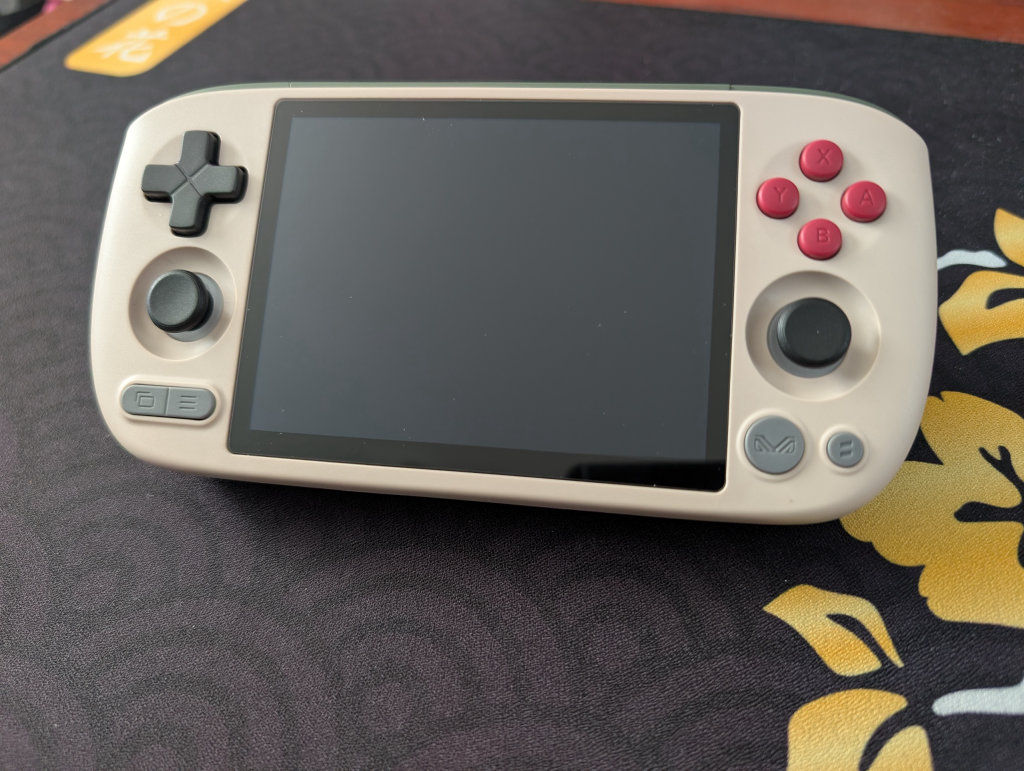
The AYANEO Pocket Air Mini has the following hardware specs:
- Display: 4.2″ 1280×960 60hz LCD at 4:3 aspect ratio
- CPU: Mediatek Helio G90T
- GPU: Mali-G76 MP4
- RAM: 2GB / 3GB
- Storage: 32GB/ 64GB
- Battery: 4500mAh
- Colors: Aurora Black, Retro White, Retro Power
- Connectivity: USB-C, microSD, 3.5mm Audio Jack, Wi-Fi + Bluetooth 5.0
- OS: Android 11
- Dimensions: 166 x 83 x 28 mm
- Weight: 274 grams

AYANEO Pocket AIR Mini
AYANEODevice Comparison
Holding both of these devices in my hands, it’s hard to consider either one of them “budget”. I’ve gone through dozens and dozens of handhelds, and the build quality on both of these is pretty surprising in a handheld that costs less than $100.
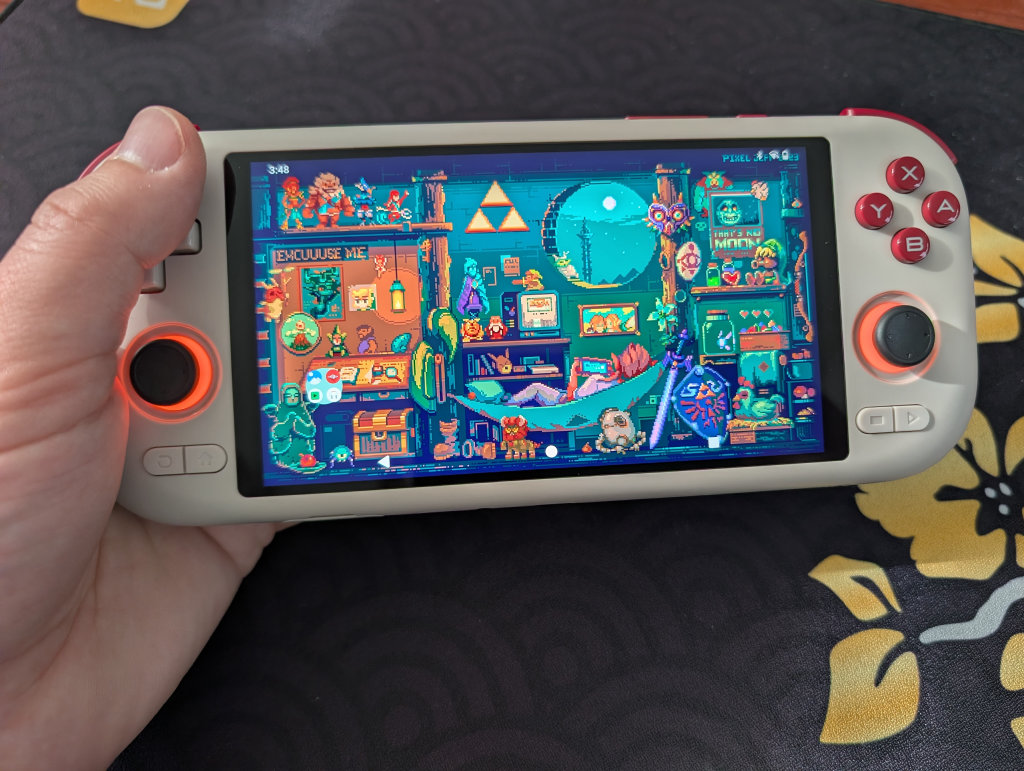
For the Mangmi Air X, while it is certainly heavier than the AYANEO Pocket Air Mini on a scale, it feels much lighter in the hand. The increased width of the Air X better distributes the weight, almost leaving the Air X with a “hollow” feeling that makes it feel slightly cheaper. Pretty standard clicky buttons here with tactile feel and press, with the triggers being especially clacky.
The sticks are slightly bigger than the Pocket Air Mini, with smooth motion and good range. The screen also looks better on the Mangmi Air X, what with that 1080p IPS vs. the 960p LCD on the Pocket Air Mini. The bigger battery at 5000mAh vs. 4500mAh in the Pocket Air Mini is also a plus, though not by much.
For the AYANEO Pocket Air Mini, it actually feels denser in the hands than the Mangmi Air X, even though the latter is heavier on the scale. It has a nice weight and balance, reminding me a lot of my Anbernic RG CubeXX. Due to this, the Pocket Air Mini has a bit of a more “premium” feel in the hand.
However, the buttons on the Pocket Air Mini might be the mushiest I’ve ever felt from an AYANEO device. The ABXY buttons, D-Pad, and triggers especially have a nearly “loose” feeling to them, just because the buttons are so soft-pressing. This would, however, make for an excellent device to play in bed, given how quiet all the buttons are.
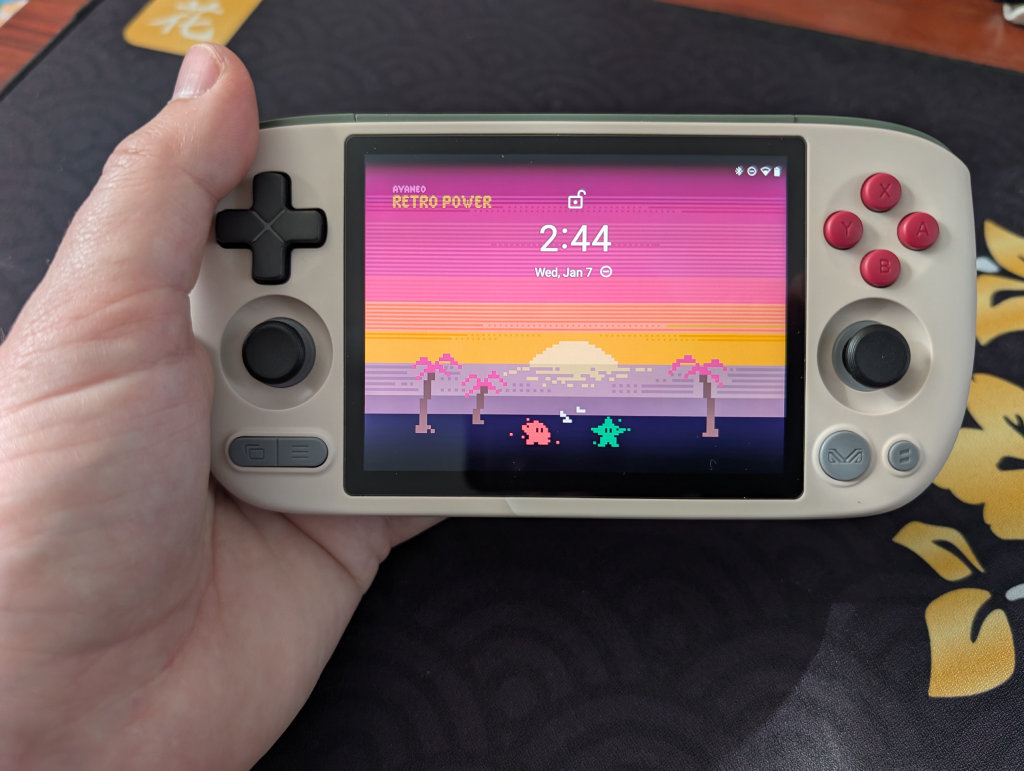
The analogue sticks are also *tiny*. which, combined with them being more recessed into the device, results in the Pocket Air Mini feeling like it has less motion and range on the sticks. A bit hard to tell, but I also think the speakers are better on the Pocket Air Mini. The M1 and M2 function buttons on the top of the device, next to the shoulders was a welcome surprise as well.
Performance Comparison
*Tests were run on both devices at 50% brightness, using OpenGL when available, with minimal hacks/enhancements enabled. Performance could likely be improved with some additional tweaks here and there, but this was meant to be an out-of-the-box setup and play experience.*
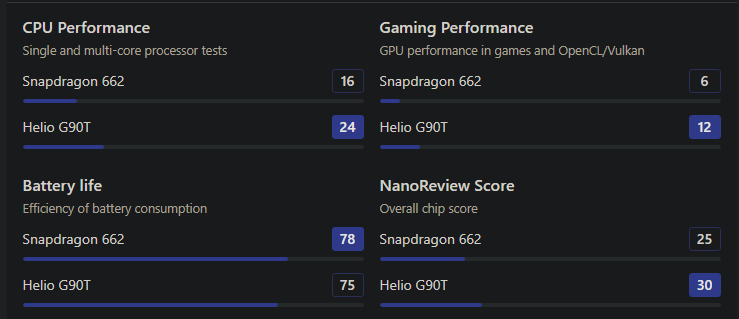
Looking at those two different CPUs (and taking the below graph into account), the Mediatek Helio G90T looks better right off the bat. As Ban mentioned in his review of the Mangmi Air X, the Snapdragon 662 is not an overly performant chip, similar in power to that of the Retroid Pocket 2S. However, both devices emulated the same games surprisingly similar, with the Mangmi Air X only really falling behind when the resolution was cranked or on more demanding games.
Game Boy Advance, PSP, and 4:3
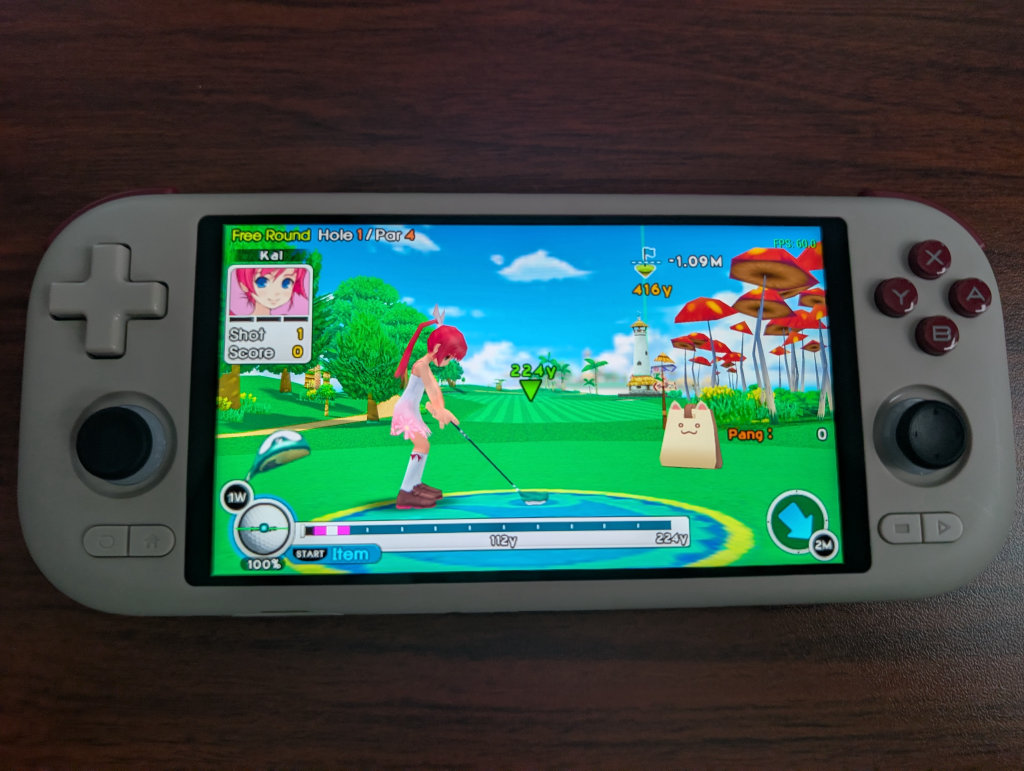
Both devices knock anything PlayStation Portable and below out of the park; GBA and PSP are going to look better on the wider Mangmi Air X, while all 4:3 content like N64, PlayStation 1, Dreamcast, etc., will look better on the AYANEO Pocket Air Mini.

Pretty standard fare here; you’ll get some vertical black bars on the Air X when playing 4:3 content, and horizontal black bars on the Pocket Air mini when playing PSP and GBA.
GameCube
GameCube performance was a bit of a surprise. The Mangmi X more consistently maintained better FPS, potentially due to compatibility with the Snapdragon chip.
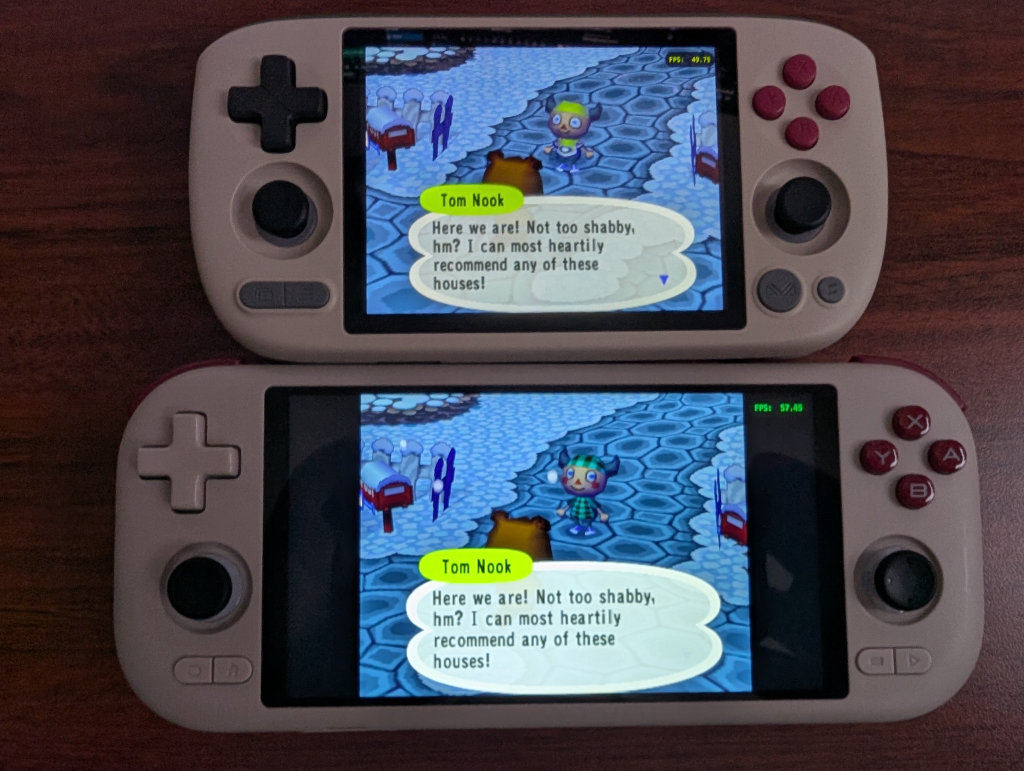
On an easier-to-run title like Animal Crossing at 2x resolution, the AYANEO Pocket Air Mini was averaging around 50 fps, and the Mangmi Air X was averaging around 58 fps, with both having some dips during transition scenes. Dropping the resolution to Native bumped the Air X to a pretty consistent 60 fps, while the Pocket Air Mini averaged roughly 52 fps. The Air X also had the fan kick in periodically to help compensate.
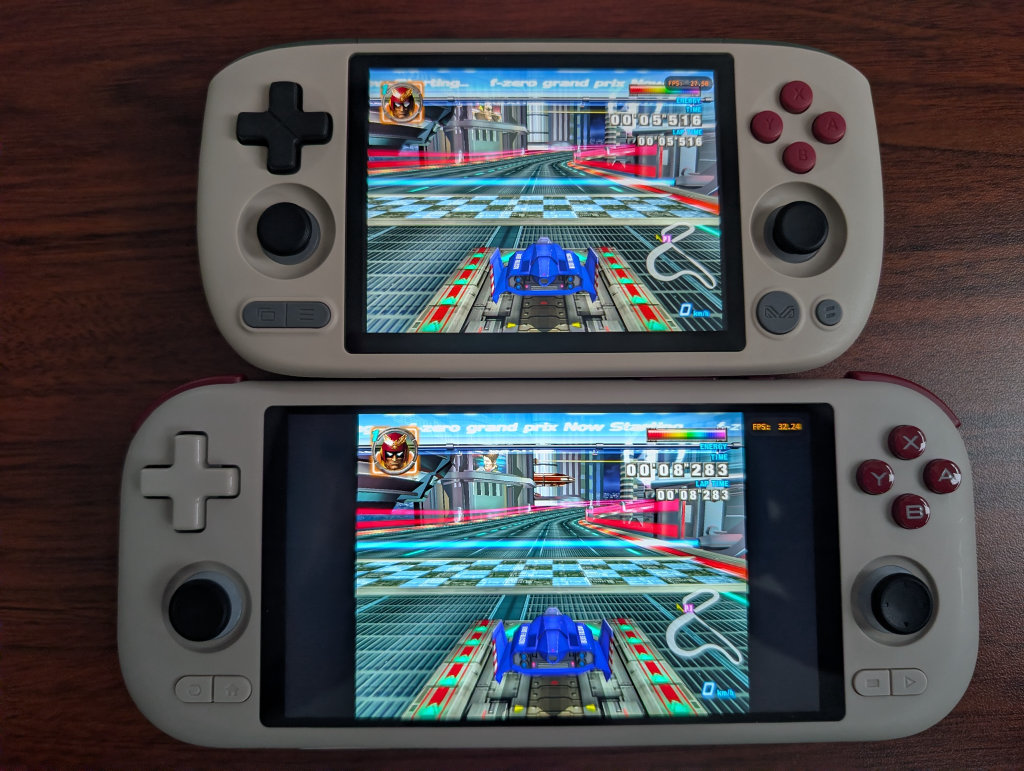
On a more demanding title like F-Zero GX, both devices struggled at 2x resolution, with dips into the 15 fps common and actual racing hovering around a fairly playable 30 fps. Dropping the resolution to Native helped increase the actual racing segments to a more playable 40-45 fps, with some jumps into the 50-60 range when there was less going on in the background. Performance was sluggish for both, with the Air X getting the slight nod here.
Wii
Wii performance is where things start to favor the AYANEO Pocket Air Mini a bit, which is a shame considering that Wii games look better on the 16:9 Air X screen. I emulated using games that play well with a Classic Controller, because trying to do WiiMote controls on a standard handheld sucks, and I’m simply not willing to mess with setting that up.
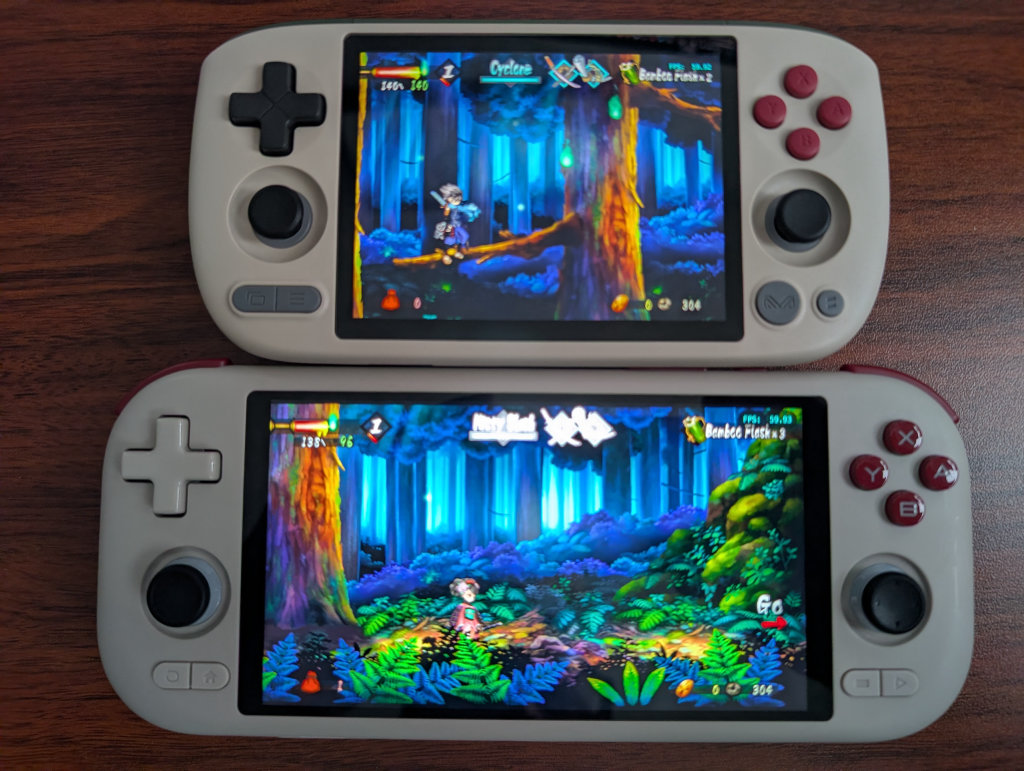
On an easier-to-run title like Muramasa, both devices were easily maintaining a consistent 60 fps at Native resolution, both in traversal, transition, and action scenes. Bumping this up to 2x resolution had the Mangmi Air X tank to around 30 fps, with the Pocket Air Mini experiencing some frame dips periodically. The fan was kicking on hard here for the Air X as well.
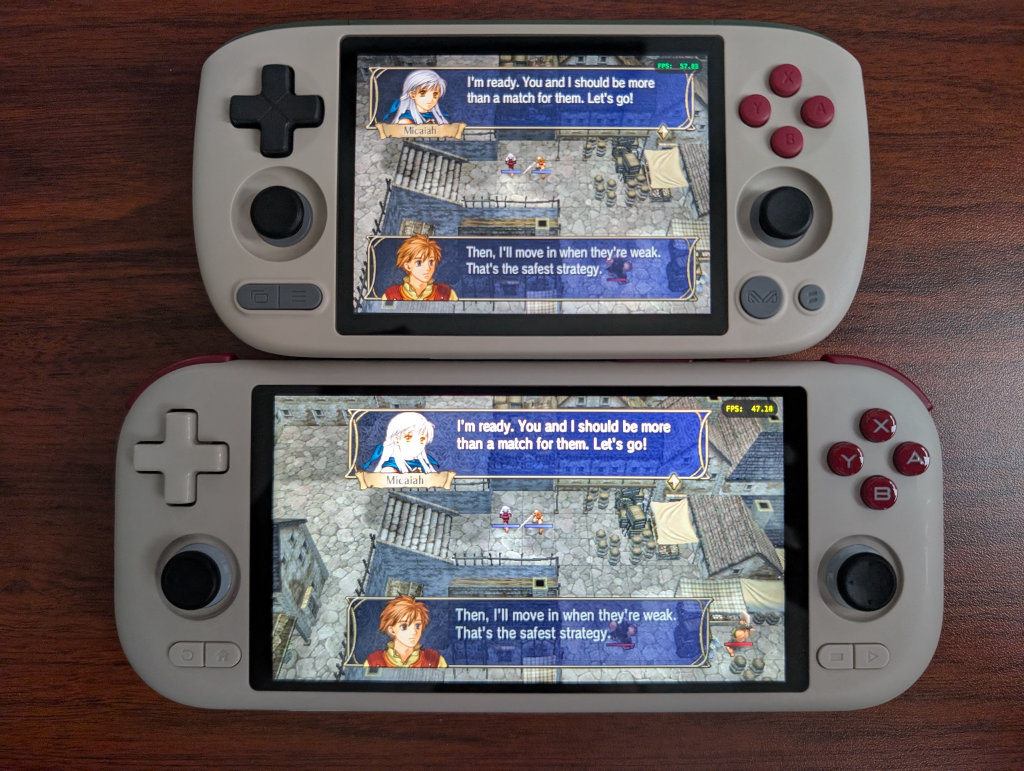
In a more difficult to run title like Fire Emblem: Radiant Dawn, both devices again were pretty consistently maintaining 60 fps in cutscenes, but gameplay would drop the framerate down to the upper 50s for the Pocket Air Mini and 40-50 fps for the Mangmi Air X. Bumping this up to 2x resolution once again had the Air X tank to about 23 fps, while the Pocket Air Mini dropped to roughly 40 fps. More fans for the Mangmi Air X.
PlayStation 2
PlayStation 2 performance entirely depends on the game that you’re looking to emulate. I wouldn’t buy either of these devices with the explicit intention to play PS2 games.
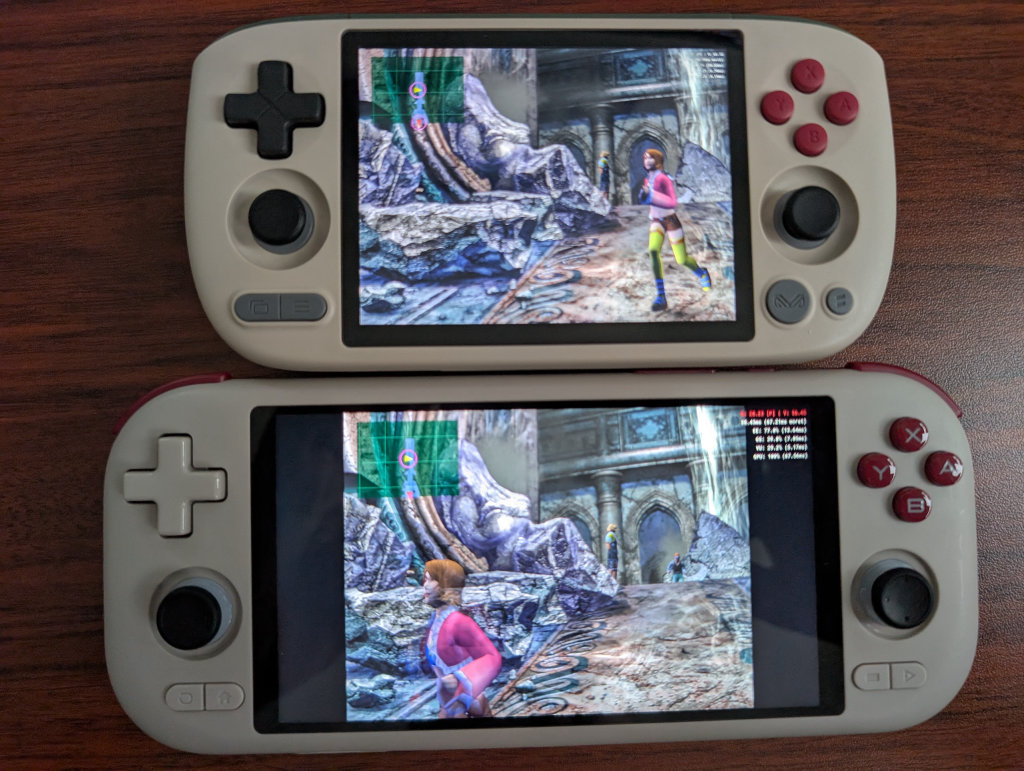
Easier to run games like Final Fantasy X have both the Mangmi Air X and the AYANEO Pocket Air Mini running a pretty consistent 60fps at 3x resolution, with the fan in the Air X kicking in periodically to compensate. There were some early second-long dips in the opening Blitzball FMV and gameplay where the Air X dipped in the upper 40 – 50fps range, but otherwise pretty consistent. The Air X did seem to be using quite a bit more CPU and GPU to get the job done, though.
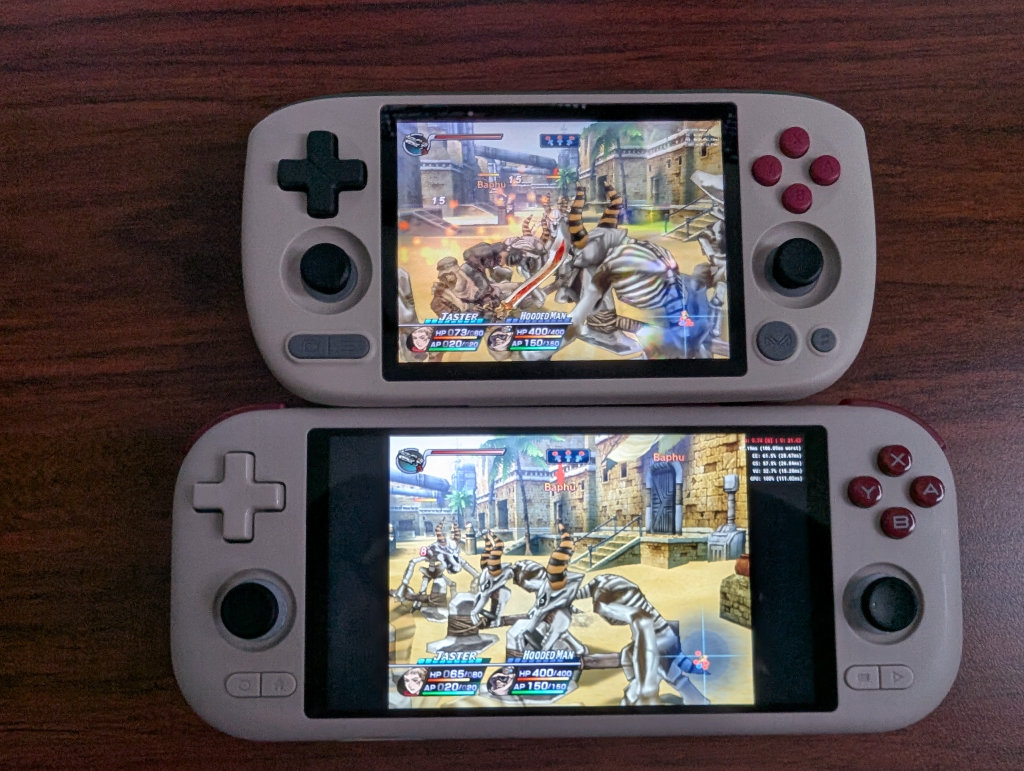
More intensive games are where things started to fall apart. Rogue Galaxy had both devices struggling a lot at 3x resolution, with the Air X doing about half as well (10-15 fps range) as the Pocket Air Mini (25-30 fps range). Dropping the resolution to 2x didn’t help a whole lot, while dropping to Native resolution gave the Pocket Air Mini a more breathable 35-40 fps, while the Air X continued to struggle at 15-20 fps and was chewing up 100% GPU usage.
Switch, PS3, and Wii U gameplay was not tested on these devices, as neither device would run them well or at all.
Additional Consideration
Worth noting – the Mangmi Air X has a GammaOS build available (though currently only for Patreon backers). While this isn’t necessarily a deal breaker or decision maker between the two devices (and GammaSqueeze is almost certainly going to have a build-out for the Pocket Air Mini before too long), this is something that I wanted to mention as I know there are plenty of members within the community who prefer a more Android-lite build when it comes to their handhelds.
A second consideration, that may only really affect a certain group of people, is that the Pocket Air Mini has some pretty noticeable ghosting. I’m generally not susceptible to ghosting, as I was someone who either didn’t have it or didn’t notice it on my AYN Odin 2, but I feel like I notice it on this device.
Especially on the AYA Home screen, when moving between the docked and undocked apps, there’s a noticeable blur. This is one of those things that not everyone is going to notice, and I thankfully noticed it substantially less in gameplay, but it felt important to mention.
Conclusion
Both of these devices provide surprisingly great performance in the sub-$100 space in the retro handheld community. Given that these two devices have different aspect ratios, it actually feels quite appropriate to recommend these as companion devices. The Mangmi Air X does well for PSP, GBA, and Wii, while the AYANEO Pocket Air Mini does well for Dreamcast, Nintendo 64, PlayStation 1, GameCube, and other 4:3 retro content.
If, however, you can only get one of these devices, then my recommendation goes to the AYANEO Pocket Air Mini. This is a bit of a difficult call; The Mangmi Air X is really good at the systems it plays the best, and I prefer the screen on the Mangmi Air X, but in terms of pure performance, the Pocket Air Mini can do everything the Air X can and more, while managing a slightly more premium feel.
However, I’m a bit disappointed in the tangibles of the Pocket Air Mini; The screen is not as sharp or vibrant as the Air X, being a bit of a dull screen overall, and the ghosting is obviously a letdown. The buttons and sticks are also a bit disappointing on the Pocket Air Mini.
Let’s be honest, though, we’re talking about two devices that are both available for roughly $100. It’s nitpicking, and at the end of the day, it’s hard to go wrong with either!
AYANEO Pocket AIR Mini
AYANEOWhat did you think of this article? Let us know in the comments below, and chat with us in our Discord!
This page may contain affiliate links, by purchasing something through a link, Retro Handhelds may earn a small commission on the sale at no additional cost to you.

2 Comments
What is this, boycott over?
Where did you get that Zelda wallpaper, that’s incredible and I need it desperately lol.
Tbh I get these 2 confused in my head because the names are so similar, but they both looks like great device, especially for the price. I’m happy with my RP5 but man, I’m definitely tempted to get one of these as a backup.